A $4-a-gallon gas spike in 2008 reshaped our rankings. The top pick still might surprise you.
See All 27 Photos 27
[This story originally appeared in the August 2008 issue of MotorTrend with the headline "High Stakes."] You’d think that just gathering up and comparing 10 hugely popular mainstream sedans would be interesting enough without needing to resort to cheesy automotive metaphors.
0:00 / 0:00
Anyhow, a cheesy metaphor I can’t bear to waste relates to efficiency: In the Tehachapi hills, east of Mojave, our real-world drive route took us up among vast stands of sequoia-tall windmills. Hundreds and hundreds of them. Big ones, smaller ones, all of them fascinating, though, apparently, if you stare at them too long, their monotonous twirling can put you under some type of spell. There are terrifying signs of it among the residents of Tehachapi—they stop at stop signs, use their turn signals, smile at you. Creepy. Hope it doesn’t spread to L.A.
Metaphor? The participants of our 10-sedan caravan were universally powered by their more efficient, smaller four-banger engines, instead of their lustier but gas-grogging V-6s. Not only does this base-engine belt-tightening drop our fleet’s typical price by about two grand, or nine percent (almost 11 grand in the case of the Passat’s pricey VR6), but it ratchets up their all-important mileage by an average 11 percent.
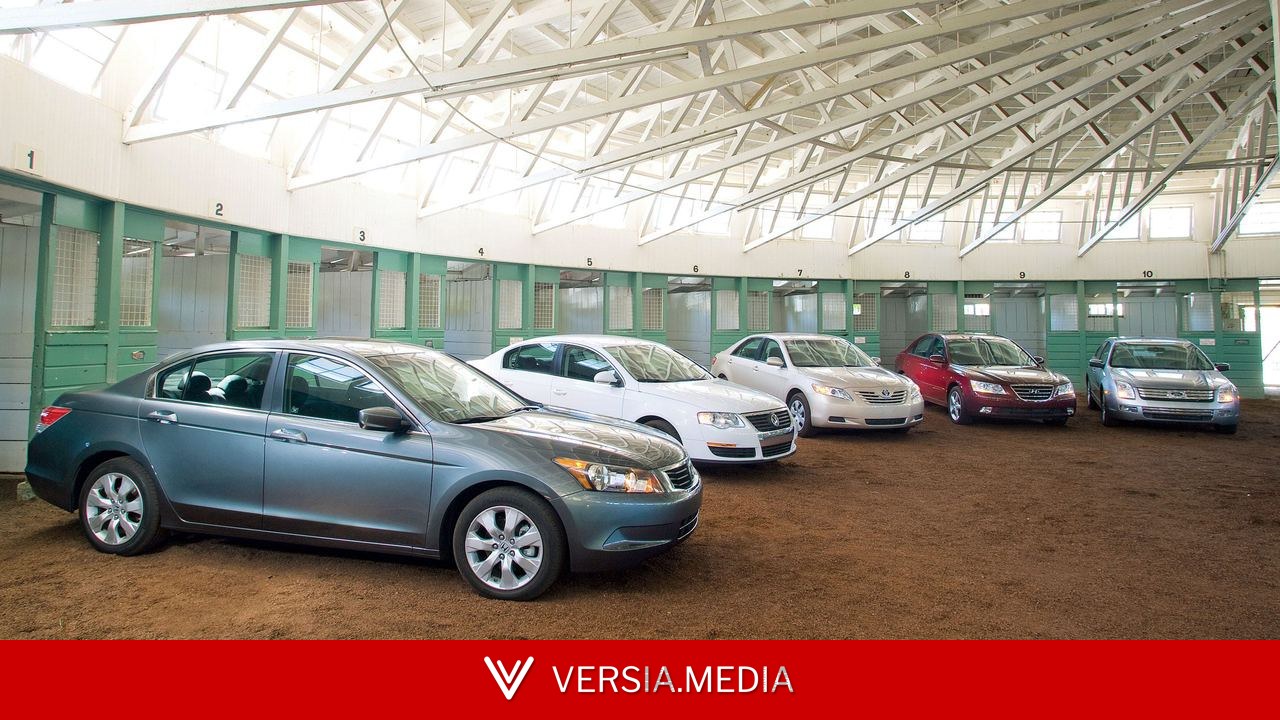
Another metaphor (the last, we hope) relates to our photo location, the classic horse-racing mecca of Santa Anita. What’s the sport of kings got to do with cars of the masses? High stakes, baby. If you add up the sales of all 10 of these cars, they account for about 8.5 percent of the entire American car and truck market. That’s something like $9.3 billion. Makes horse racing look like an evening watching Baby Einstein.
As I said, we tested the bejezzers out of 10 sedans—Chevrolet Malibu, Dodge Avenger, Ford Fusion, Honda Accord , Hyundai Sonata , Kia Optima, Nissan Altima , Mitsubishi Galant, Toyota Camry , and Volkswagen Passat. But unless you happen to be hot-to-trot “in market” and are perched on the edge of your seat right now, the Michener-scale tome we’d need to convey all this would make your eyes bleed. Not wanting that, we’ve divided and conquered by highlighting the group’s cream of the crop—our favorite five, the Accord, Sonata, Camry, Passat, and Fusion.
See All 27 Photos 27
The Price of Gas Changed Everything
So how about we get right to the big “M”—Mileage. At the moment, sales of four-cylinder cars are absolutely on fire what with four-buck gas. That ought to make the Hyundai Sonata, in particular, a hot commodity as it apparently uses cocktail straws instead of fuel lines to feed its cylinders: 25.6 combined EPA mpg is frugal—and unexpected—as Hyundais have historically been laggards in the mpg department (a tip of the hat to Hyundai’s new Theta II engine then). This bests the Camry and Accord, which are tied at 24.6, the Fusion at 23.2, and last (among our top five) the Passat’s 22.2.
That Passat’s number seems relatively crummy—3.4 mpg worse than the Sonata's. The shiny side of this penny is a 0-to-60 mph acceleration rate that’s potentially 23 percent lustier (depends on your right foot) than the Sonata’s—6.7 seconds versus 8.7. Compared with the Fusion, it’s a rippling 28-percent harder-charging. Moreover, the Passat’s turbo engine is a broad step apart from this crowd by uncorking a uniquely slingshot-style of delivery.
The Passat’s engine is so charismatic, it nearly sucks all the air out of a discussion of the rest. Turbo engine aside, the Accord’s 190-horsepower, 2.4-liter is a revvy gem, while the Toyota’s mill, with a comparatively weakling 155 horsepower, is at least silently unobtrusive. The Fusion is double jinxed by being both doggy (9.2 seconds to the Six-O) and obtrusive, with every one of its 160 ponies contributing its own hoarse little voice to the Ford choir.
Around here, premium gas prices are running about eight percent above regular. That has exclusive significance for the Passat, equating to something like an extra $200 per year if you crunch all the usual assumptions of annual mileage, and so forth. Worth it? One of our evaluators, Arthur St. Antoine, didn’t bat an eye. “Absolutely,” he replies. Me, you’d have to slam to the floor, WWF-style, to shake loose an annual two bills for a higher-octane rating. Remind me to talk to St. Antoine’s financial advisor, though.
A last efficiency insight I’ll leave you considers how much volume you can move around for the amount of gas it’s costing you (passenger volume plus trunk volume times mpg divided by 1000 to produce a sensible-looking number). Best? 3.1 for the Sonata, followed by 2.9 for the Camry, 2.8 for the Accord, the Fusion at 2.7, and the Passat with a 2.4. That’s a notable 30-percent variation between best and worst.