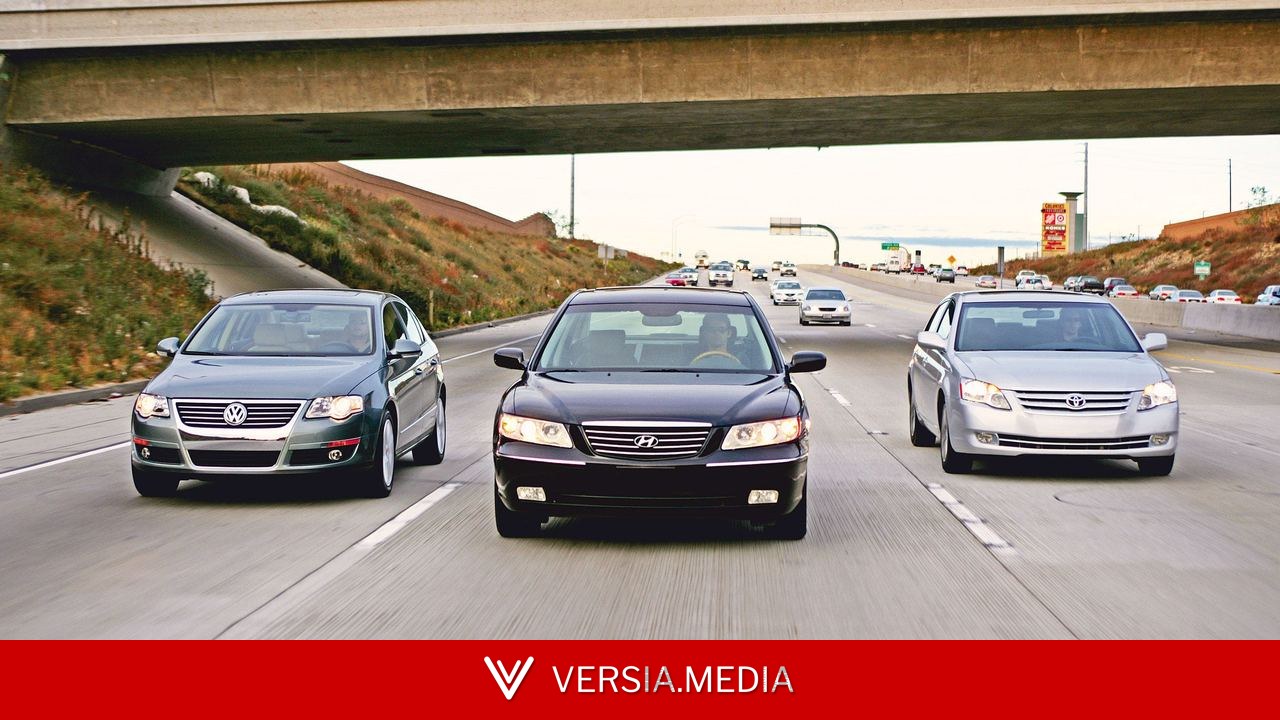
A trio of family sedans fought for the middle ground. One delivered the winning balance.
See All 29 Photos 29
[This story originally appeared in the March 2006 issue of MotorTrend with the headline "Movin’ On Up."] “So just what category do these three cars fall into?” someone asked during a staff meeting as we moved to the next subject on the agenda, a planned comparison of the Volkswagen Passat, Toyota Avalon, and Hyundai Azera.
0:00 / 0:00
After a moment of typical befuddlement around the conference table, our chief categorizer of things cleared his throat: “Well, think of them as aspirational four-door sedans . Modern versions of your upwardly mobile Dad’s Buick or Mercury. A step up from a Ford or a Chevy, but a notch below a Lincoln or a Cadillac.”
In other words, what our fathers drove as they dreamed of their Eldorados (auricular and vehicular). Many of those dreams are now warehoused in Motor Trend’s vast archives. Among them is a philosophically spot-on antecedent of this trio in the form of an April 1972 matchup of that year’s Mercury Marquis, Pontiac Grand Ville, and Dodge Monaco (which always looks like it’s headed the wrong way). “They’re big, hard to park, and don’t handle too well, but it sure feels good when you slide behind the wheel of any of them—and that’s what these cars are all about.”
Of course, aspirational cars should make you feel good when you slide behind the wheel, but today’s updated editions are no longer big and clumsy. While the interiors of the Passat, Avalon, and Azera are cozier than those of their forebears, clever packaging has lopped whole feet from their exterior dimensions, yielding a packaging efficiency unheard of in Dad’s day. And, comparatively, they can spank through traffic like banked billiard balls. (Much appreciated in the freeway congestion we encountered attempting to reproduce that 34-year-old comparison photo.)
See All 29 Photos 29
Three Sedans, Three Different Ideas of Success
Given that the Toyota Avalon has long been comically mute as a design statement, that this one’s suddenly a visual chatterbox of bevels comes as a pleasant surprise. Some of us smiled at the sculptural boldness: “At least, it’s interesting for a change.” Others grumbled: “The tall doors make for a thick beltline that comes off as badly proportioned.” “Too many unnecessary angles.” Coincidence perhaps, the same might be said of the cars in our 1972 comparison.
The controversy ceased at the Avalon’s door, however. Inside, the driver’s studio is clean, crisp, and organized. The dash of our Touring example was brightened by a sleek, silverized center stack that neatly conceals its audio paraphernalia behind touch-opened doors. At night, this is elegantly framed by large, translucent buttons for the climate controls, which at nightfall acquire the look of glowing ice cubes. We prefer the Avalon’s approach of unifying the sound system and climate settings into one easy-glance display (although the graphics employed are amusingly Pong-era in style).
Because it’s a Toyota, you’d expect high standards in materials and craftsmanship, but what’s most remarkable is the penthouse dimensions of the back seat. Positioning the front seat for our standard-seating mannequin (an average-dimension six-foot male), the rear seat affords our same mannequin 6.2 inches of knee room—yep, half a foot. That’s 2.4 more than in the Azera, 3.2 more than in the Passat, and the sort of stretch space a pricey ticket buys you on Virgin Atlantic. If you’re proportioned like Skeleton Jack in the Nightmare Before Christmas, here’s the back seat for you (and seatback, too, given that it reclines up to 10 degrees). Some of this comes at the expense of trunk capacity, however, which falls 13 percent short of the Azera’s and five inches shorter in floor length than the Hyundai’s and Volkswagen’s.
See All 29 Photos 29
In motion, Toyota’s flagship extends the limousine impersonation with, shall we say, noticeable silence and astute absorption of road imperfections. Our accelerometer measurements over a favorite test surface (encompassing railroad tracks and six miles of varying-quality asphalt) showed the Avalon to be a close second in ride to the Azera. However, its expressed vibrations were better spread over the frequency range, rendering them tougher to identify (i.e., its ride quality’s version of “white noise”). Surprisingly, at a stop, the idling Avalon is also louder than the Azera, the Toyota registering 43.0 dBA versus the Hyundai’s whispering 38.0 and the Volkswagen’s 43.5.
Given the stick, the 3.5-liter V-6’s 268 horses put on a good show, launching the Avalon to the 60 mark in a purposeful 6.2 seconds, punctuated by subtle hints of gearshifts. An esoteric detail (given the Avalon’s typical clientele) is the engine’s genuinely refined bark as it climbs past 6000 rpm. As with the other two cars, the shifter offers a manumatic slot, but, unlike theirs, it’s handily offset near the driver—a quick grab, should the demons speak.
And when they do, our Touring-edition (more firmly suspended) Avalon is a better sport(ish) sedan than you’d think, though our clocks report it to be a half step behind the Passat and Azera in absolute slalom and skidpad pace. Like the Azera, it’s perilously nose-heavy with a 61/39 front/rear weight distribution, but Toyota’s stability system turns out to be a particularly cushy catcher’s mitt, grabbing wayward chassis gyrations without a stinging rebuke back to the driver.
At the track, we paid extra-close attention to our trio’s handling quality (what with this being the first thing that goes when ride comfort counts.) Specifically, we zeroed in on three issues: steering effort, steering reaction time, and steady-speed under- steer/oversteer—all these appraised at a brisk (but not atypical) 0.5 lateral-g cornering rate.
Turns out the Avalon actually understeers the least (surprise), needing 1.4 degrees of additional front-wheel angle to produce our half-g cornering pace around the skidpad (the Passat registered next at 1.5 degrees, the Azera last at 1.6—that’s 14-percent- more understeer than the Avalon). Further, the Toyota required the least effort (3.5 pounds) to maintain that cornering rate.
See All 29 Photos 29
That’s lightish, but on the edge of plausibility for a serious driver’s car. Our third query is called the “step-steer test,” wherein, starting from a straight path, the steering is quickly flicked an amount that’ll yield our target 0.5 g. Reaction time in the duration between flick and steady cornering is the focus here. The Avalon’s fell midpack, more sluggish than the Passat’s, but a tad livelier than the Azera’s.
In fact, the Azera proved a particularly tardy and inconsistent step-steerer. Senior road-test editor Walton reported much the same after weaving through the higher- speed slalom: “The tires initially bite well off-center, but the chassis is uncertain after that. The car seems to rely a lot on its tires and less on its suspension compared with the other two.” Notably, it also demands the highest steering effort, 4.5 pounds.
However, during emergency braking, the tires’ grip was directly evident, helping the Azera stop some five to six feet shorter than the others. Walton: “You can really feel and hear these Michelins biting into the pavement. And the ABS is pleasantly unfussy.” Not bad for a car that’s 240 pounds heavier than the Avalon and 180 pounds porkier than the Passat. (In fact, we reweighed the Azera, wondering if road- test editor Neil Chirico might still have been in the car when the electronic scales were on.) We’d point to that layer of - automotive fat as the most probable reason for the 0.6 second the Hyundai lags the Toyota and Volkswagen to 60 mph (though being down 5-17 horses doesn’t help.)
See All 29 Photos 29
Weightier chassis or no, the Azera’s structure is prone to structural quivers. Nothing Galloping Gerty-scale, but it was apparent over our ride test road, where the car’s natural, slow floatiness was often augmented by episodic flutters. In fact, its lateral shudder is measurably higher.
The Azera represents yet another pearl in a string of recent Hyundais that leaves you sputtering in amazement. In this case, the South Koreans have seemingly replicated Buick’s recipe overnight, nailing attribute after attribute: plump seats, a mature- looking (if mildly incoherent) interior, a relaxed highway gate, and graceful but subdued bodywork. Our Azera’s cabin felt like a conservative executive’s office, awash in serious flannel grays, minimally relieved by streaks of lighter woodgrain accent.