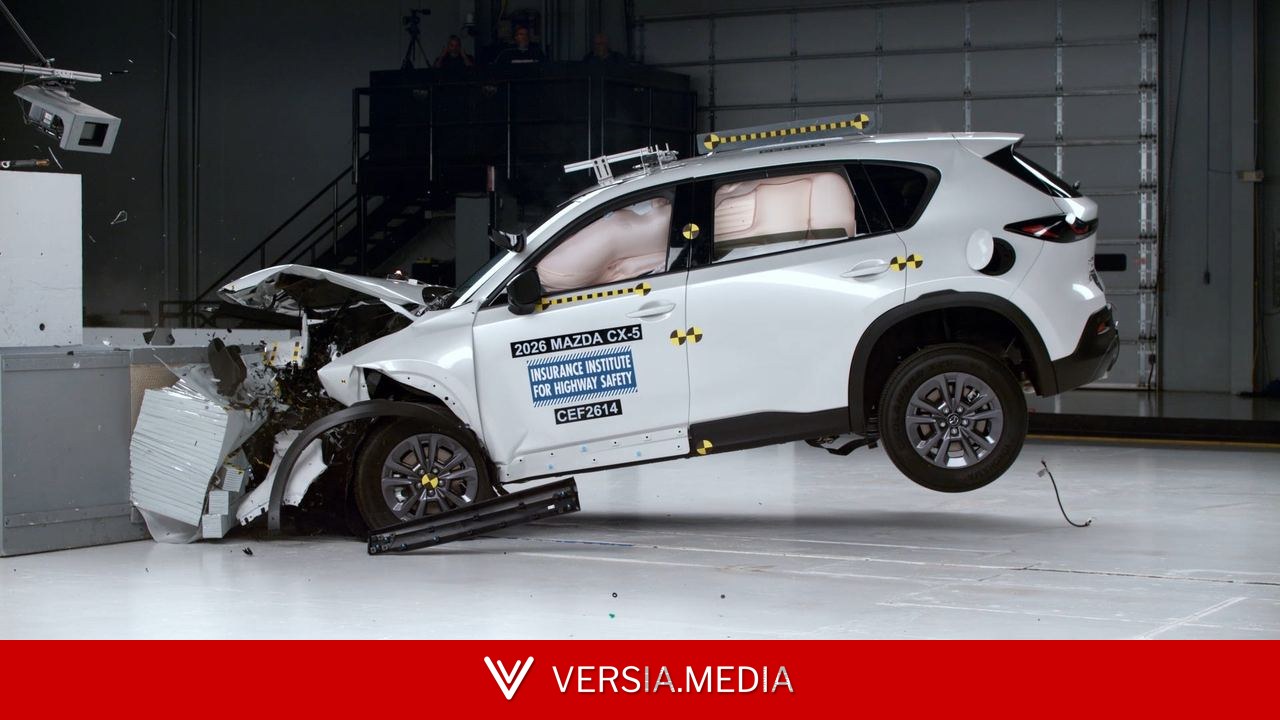
The CX-5 joins eight other Mazdas in achieving the IIHS’ highest safety award for 2026, the most of any U.S. brand.
See All 11 Photos 11
The results are in, and the 2026 Mazda CX-5 has been dubbed an Insurance Institute for Highway Safety (IIHS) “Top Safety Pick+,” one of the highest safety awards in the automotive industry. What’s more, the CX-5 is now the ninth 2026 Mazda vehicle to achieve TSP+, a number that cements Mazda at the top of the list of safest automotive brands in North America by model.
0:00 / 0:00
Other 2026 Mazda models earning the 2026 IIHS TSP+ award are the Mazda3 sedan, Mazda3 hatchback, CX-30, CX-50 (including CX-50 Hybrid), CX-70, CX-70 PHEV, CX-90, and CX-90 PHEV.
“Earning an IIHS Top Safety Pick+ award for the 2026 CX-5 reflects Mazda’s commitment to protecting those who trust us with their safety every day,” said Jennifer Morrison, Mazda North American Operations, director of vehicle safety strategy. “By combining thoughtful engineering, human-centric design, and advanced safety technologies, we are creating vehicles that help prevent crashes and better protect occupants—all in pursuit of our goal of zero fatalities in Mazda vehicles by 2040.”
See All 11 Photos 11
The IIHS moderate overlap front crash test was last updated in 2022. The new test puts a strong focus on the safety of the rear passengers.
Crash Course: What Are IIHS TSP and TSP+?
The IIHS is an independent, nonprofit automotive safety organization funded by insurance companies that tests various automotive safety systems, most notably crash test performance, and increasingly, the latest advanced driver assistance systems (including but not limited to automatic emergency braking, adaptive cruise control, and headlights). It rates vehicles on a four-level scale: good (best), acceptable, marginal, and poor.
For 2026, its Top Safety Pick+ (TSP+) requirements got even tougher by placing more emphasis on protecting rear-seat passengers and preventing crashes. To earn the award, a vehicle must now receive the highest “good” rating in the small overlap front, updated moderate overlap front, and side-impact crash tests. Vehicles also must earn good or acceptable ratings for their standard headlights, a good rating in the pedestrian front crash prevention test, and a good or acceptable rating in the latest vehicle-to-vehicle front crash prevention test, which evaluates how well automatic emergency braking systems avoid or reduce crashes in more demanding situations. All required safety features must be standard equipment on every trim level.
See All 11 Photos 11
In the IIHS moderate overlap front crash test, 40 percent of the front impacts a fixed barrier while the vehicle is traveling at 40 mph.
The "+" in Top Safety Pick+ indicates that a vehicle meets its highest possible safety standard. Compared with the regular Top Safety Pick award, TSP+ has stricter requirements, particularly for crash avoidance. In 2026, TSP+ winners must earn a good rating in the pedestrian front crash prevention test and also achieve a good or acceptable rating in the vehicle-to-vehicle front crash prevention evaluation.
We attended a Mazda-hosted crash test of the 2026 CX-5 at the IIHS headquarters, which focused on the newer, more difficult moderate overlap crash scenario, in which the vehicle impacted a stationary barrier at 40 mph. The impact does not occur directly head-on, but is offset 40 percent favoring the driver’s side; meaning 60 percent of the front of the vehicle misses the barrier, forcing the front structure to absorb crash energy asymmetrically and causing chaos in the rear passenger space. This way, the updated test measures the potential injury not only to an adult-sized dummy (representing a 50th percentile adult male, by height and weight) placed in the driver’s seat, but also to a smaller dummy, meant to represent a 12-year-old child, belted into the left rear passenger seat.
See All 11 Photos 11
Two crash test dummies are positioned inside the vehicle, with sensors at key positions around their bodies, and red and blue grease paint on their face, to show which airbags they hit.
The biggest change from the original moderate overlap test is the emphasis on the rear passenger as the original test focused almost entirely on driver protection. The updated version is intended to push automakers to provide rear-seat occupants with the same kinds of advanced safety features—such as seat belt pretensioners, load limiters, and improved airbags—that have long benefited front-seat passengers.