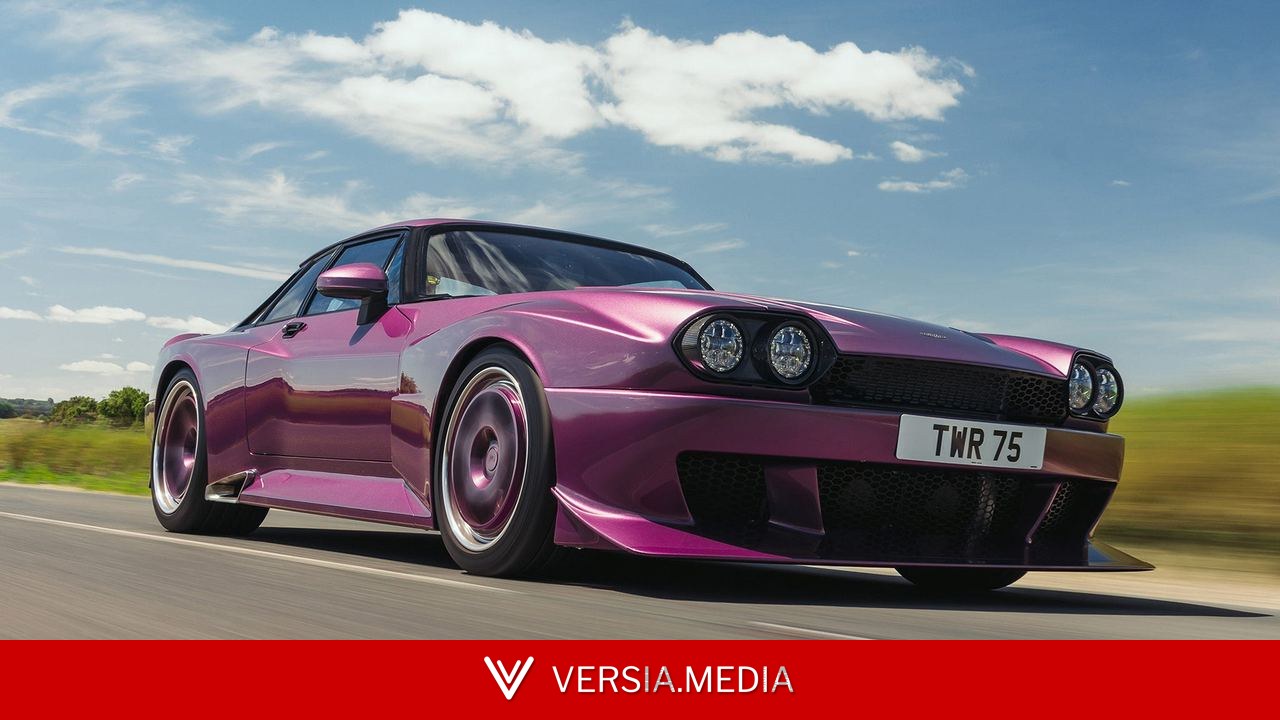
The Supercat is a wild restomod by TWR, which traces its ties with Jag back to the 1970s.
See All 36 Photos 36
BY OLLIE MARRIAGE | PHOTOS BY MARK RICCIONI | The British have built a muscle car. No, there is not a V-8 under the hood, but how about a V-12 instead? A supercharged V-12 no less, one that drives the rear wheels through a six-speed manual gearbox? Meet the TWR Supercat . Somewhere underneath its wild bodywork lies the skeleton of an old Jaguar XJ-S, but let’s just say it’s had something of an upgrade.
0:00 / 0:00
The Supercat is technically a restomod. We’re used to those being precious, sculptural cars that flatter the model they’re based on, turning it into something artistic and giving it a carefully cultivated image while adding some modern conveniences and mechanicals. This is not one of those restomods. Sympathy for the old XJ-S has been lacking as the designers seemingly vanished down an ’80s wormhole. The Supercat looks as if it beamed here straight from the decade that gave us shoulder pads, neon clothes, and synthesizers. It looks like it probably has them stashed in the trunk, to be honest.
It has swagger, that’s for sure. The flared and boxed wheel arches broaden the car by more than 7 inches, the front splitter seems to have been modeled on a submarine dive plane, and the rear wing sweeps up from the back deck nearly as dramatically as the buttresses sweep down. Split-rim wheels, side-exit exhaust pipes, and a multitude of vents add extra visual spice. It’s boisterous and brutish but dressed like Prince in his purple pomp—you can’t deny it’s got the look.
See All 36 Photos 36
An original XJ-S isn’t like this. It’s all olde worlde tweedy charm, a grand tourer. They did once try to turn it into a sports car, the XJR-S, but saddled it with a three-speed automatic that didn’t help its cause. Produced by Jaguar from 1975 to 1991, the XJ-S was intended to be a replacement for the E-type but mostly lived in that iconic car’s shadow, criticized for not having the E’s dash and glamour. It had a V-12, but one from the era when V-12s—British V-12s at least—were smooth, silent, whirring devices rather than beefy performance powerplants. And its suspension was best described as “unhurried.” The XJ-S was a land yacht.
The Supercat exists on another level altogether. But at its core and—most important—according to its VIN plate, it remains an XJ-S. And this is something TWR (a spiritual successor to Tom Walkinshaw Racing, founded in 2020) has in its soul. Back in the ’80s, Jaguar chose the original TWR as its partner to help turn the XJ-S into the production XJR-S. TWR was a race outfit, best known for winning Le Mans twice with Jaguar (1988 and 1990), taking a Volvo 850 estate Touring Car racing, and building the XJ220 supercar . I say “was” because an ill-fated attempt to reach F1 saw the firm go under.
See All 36 Photos 36
How the ’Cat Came Back
It’s now returned under the guidance of Tom’s son Fergus and done a much more thorough job with the XJ-S. The intention is to re-create some of the iconic road cars the firm was involved with first time around, the Supercat being the first. While the car’s looks get all the attention, this is an in-depth, engineering-led project. A donor XJ-S V12 is sourced and stripped until nothing remains apart from the engine block and chassis. Then the heavy metal makeover begins. Literally as well as figuratively.
The chassis gains extra bracing and support, including a new front subframe, crash structures, rear bulkhead, and roll cage. The rear seats are ditched, and the fuel tank that was mounted behind them is moved to a new position under the trunk floor. This gives a wide, flat, shallow load area that’ll swallow golf clubs and overnight bags (fitted luggage is an option) with equal ease. Carrying skis? The new bulkhead flips down into a neat recess, resulting in a passthrough.
See All 36 Photos 36
So it’s practical in a way most modern supercars aren’t. It’s also powered in a way that most modern supercars aren’t. Or in fact any modern supercars. I had assumed that back in the 1930s everyone shoved a supercharged V-12 under the hoods of Duesenbergs or Bugattis and thought nothing of it. But it turns out to be a vanishingly rare thing. Only Franklin, an American maker of premium air-cooled automobiles, briefly offered the combination, so blown 12s have been left to tuners to fill in the blank. Novitec created a twin-supercharged Ferrari 599, and in 1991, Lister put a 7.0-liter twin-supercharged V-12 in … a Jaguar XJ-S.
This car is riffing on history in multiple ways. Block aside, every component in the engine is new, the 5.6-liter design largely the work of Fergus Walkinshaw himself. Nestled between the cylinder banks is a centrifugal Rotrex supercharger—more efficient if less charismatic than a screw-type—and with that spinning away, the Supercat develops 660 hp and 538 lb-ft of torque.