We hit California's toughest grades to see which diesel truck came out on top.
See All 13 Photos 13
[ This story originally appeared in the September 2004 issue of MotorTrend with the headline "Moving Mountains." ] Sometime during the night of September 29, 1913, Rudolph Diesel, 55 years old, roughly 10 million marks in debt, and racked by debilitating headaches, disappeared from the liner Dresden as it crossed the English Channel. In Diesel's cabin was found his inventor's notebook. Under the date of his disappearance, there was nothing but a small cross, marked in Diesel's hand; 11 days later a passing ship found his floating body. At that point, there'd been little progress in commercializing the Paris-born Bavarian's highly efficient engine. And its future seemed to go over the rail along with its creator.
0:00 / 0:00
Had Rudolph Diesel, at that railing, clairvoyantly seen, say, 91 years into the future, he might not have made that fatal leap into the sea. For he would've witnessed us whistling up and down the steep incline called the Grapevine, north of the Los Angeles basin, in a trio of turbodiesel trucks towing an 8,500-pound boat and trailer rig like it was a Zodiac inflatable. There we were, the toast of the truck lane. The dandies of dieselland. Thanks, Rudy.
See All 13 Photos 13
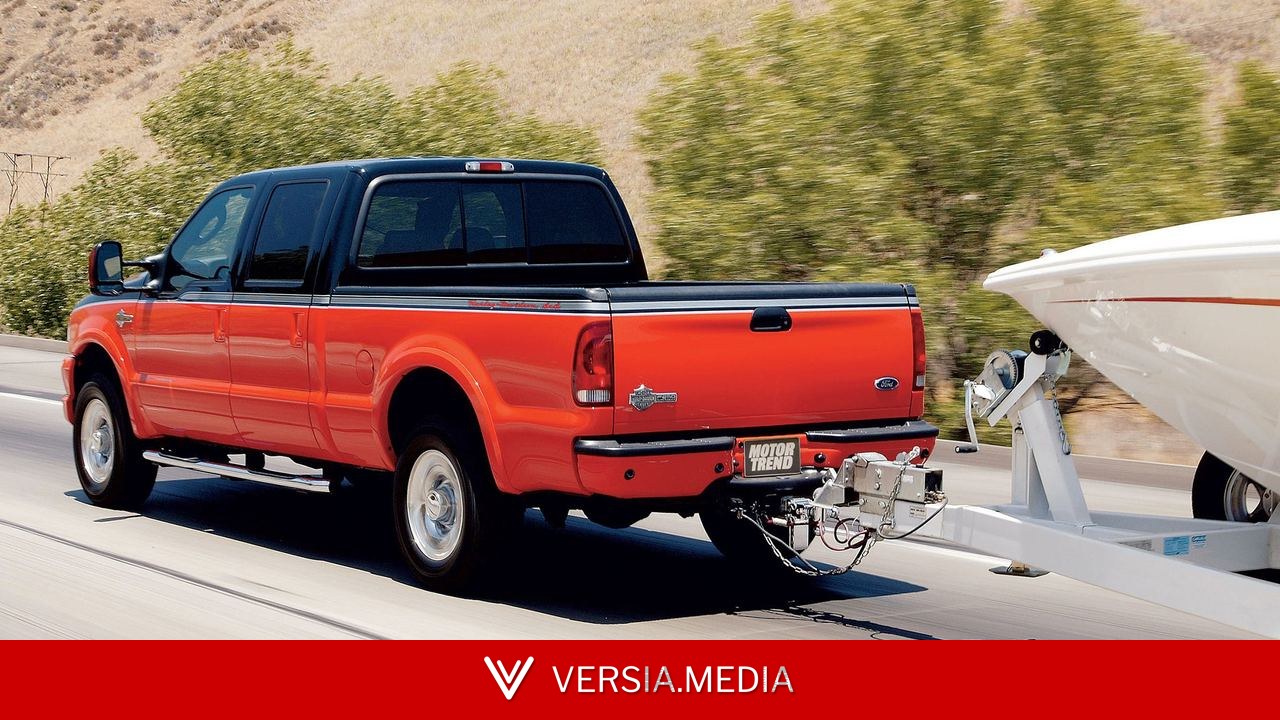
None of this is to say these behemoths make quite the same sense uncoupled from this profound payload. Trailerless, the Cummins-engined Dodge Ram 2500 4x4 Quad Cab SLT, the Duramax-equipped GMC Sierra 2500 HD 4WD Crew Cab, and the Power Stroke-propelled Ford F-250 Crew Cab 4x4 (this one in spectacular Harley-Davidson orange, black, and chromes, no less) are awkwardly incomplete arguments. Uncoupled, they're inexplicably huge. They're insanely noisy. On irregular concrete, they can erupt into fits of bull-ride shuddering that would throw you into the back seat were you not buckled in. And for your trouble, diesel refueling stations have an uncanny knack for vaporizing exactly when you need them ("please, please, let there be a fourth number on that gas station's price board...").
See All 13 Photos 13
However, with your speedboat looming in the side mirrors and a steep grade facing you in the windshield, everything snaps into logical sense. Instantly, the size is right, the roar is reassuring, the ride settles into a fluid lope. What perfect tools these three are for the megatowing job at hand. And 500-plus pound-feet of diesel torque doesn't seem the least bit excessive. In 1892, Rudolph Diesel was awarded a patent for finding a way to exploit the theoretical benefits of a high compression ratio; 112 years later, we decided it was time to explore its real-world value in our own high-compression comparison and towing matchup.
See All 13 Photos 13
3rd Place: Ram 2500
Dodge's entry in the turbodiesel sweepstakes has two big cards to play: its great looks and that intriguing Cummins engine.
At a premium of $5460 (plus $1095 for the automatic transmission), the high-output version of the Cummins engine offers a goodly list of big numbers to ponder besides its steep option price. For instance, 600 pound-feet of torque at 1600 rpm. And how about a 350,000-mile lifetime-to-major-overhaul interval—100,000 more than its competitors? The torque figure is a volatile subject in this category, 600 being a benchmark envied and targeted by the industry (see GMC's Duramax plans later in our story).
Numbers aside, the Cummins straight-six is far and away the diesel-truck guy's diesel-truck engine on a sensory level. At idle, when the GMC and Ford V-8s sound like loose quarters in a dryer, the Cummins straight-six thunders with ricocheting silver dollars. And when you comment to a Cummins owner that, gee, maybe it feels cruder than the GMC Duramax or Ford Power Stroke alternatives, they smile in appreciation of the compliment (if you said it was rougher than 60-grit sandpaper, they might even high-five you). No accusation of primitiveness will offend these people.
Pop the hood, and the sight of the Cummins High Output turbodiesel is defiantly individual as well. It's nostalgically straightforward, a huge iron block entombing a half-dozen big 4.02-inch cylinders standing shoulder-to-shoulder like a row of cannon barrels. A hefty turbocharger spins in plain sight on its right side. No frilly faux-plastic covers here: The Cummins is a grand chunk of throw-back cast-iron honesty that proudly displays its metal components—bolts, tubing, and couplings—like tattoos on a bicep. While it seems the noisiest, that's more of a perception of the engine's particularly clattery texture. In reality, our dB meter perceived it as quieter than the GMC Duramax whether we were standing in front of the truck, seated behind the wheel at idle, or accelerating hard out of the hole.
After climbing the Grapevine's grade with the boat in tow, colleague Greg Whale, editor-at-large for our sister magazine, Truck Trend, commented, "The Cummins has the most low-end grunt, whether the specs say so or not. During our climb, the coolant temperature went up 10 degrees to 205, but the radiator's clutch fan never came on. And descending the hill, the transmission's tow-haul mode [wherein the gearbox maximizes engine braking] did a good job hanging onto each gear's revs right down to 1800 before downshifting." Though the 48RE transmission was previously beefed up to handle the high-torque engine, that you can count its gears on four fingers instead of five is a constant handicap relative to the trannies in the Ford and GMC.
When it was introduced, the Ram's big-rig design motif positively rocked the business. In its current version, a double shot of truck-stop visual caffeine seems to have formed the chrome-rimmed grill into a permanent "wow!" While it may be a bit over the top for some, the Ram unerringly draws admiring glances. Inside, it's also crisply contemporary, with a beveled-edge style mingling white gauge faces and simulated brushed-metal accents into a panache the others lack.
Without the boat or a heavy payload to pacify the rear suspension, however, this good-looking interior can erupt into a violent blur on too many surfaces, as the Ram's stride sometimes dissolves into a paint-shaker ride. But while the Sierra offers the most direct and easiest steering, the Dodge notably has the tightest turning diameter, 7.7 feet smaller than the F-250's (owing to its shorter wheelbase and front coil springs instead of the Ford's longitudinal leafs).
Although nothing beats it for torque and looks, the Ram's aching need for a five-speed transmission, its kidney-busting ride, and its limited-audience Cummins engine drop it to a third-place finish here. Albeit a strong and damned appealing third-place finish.