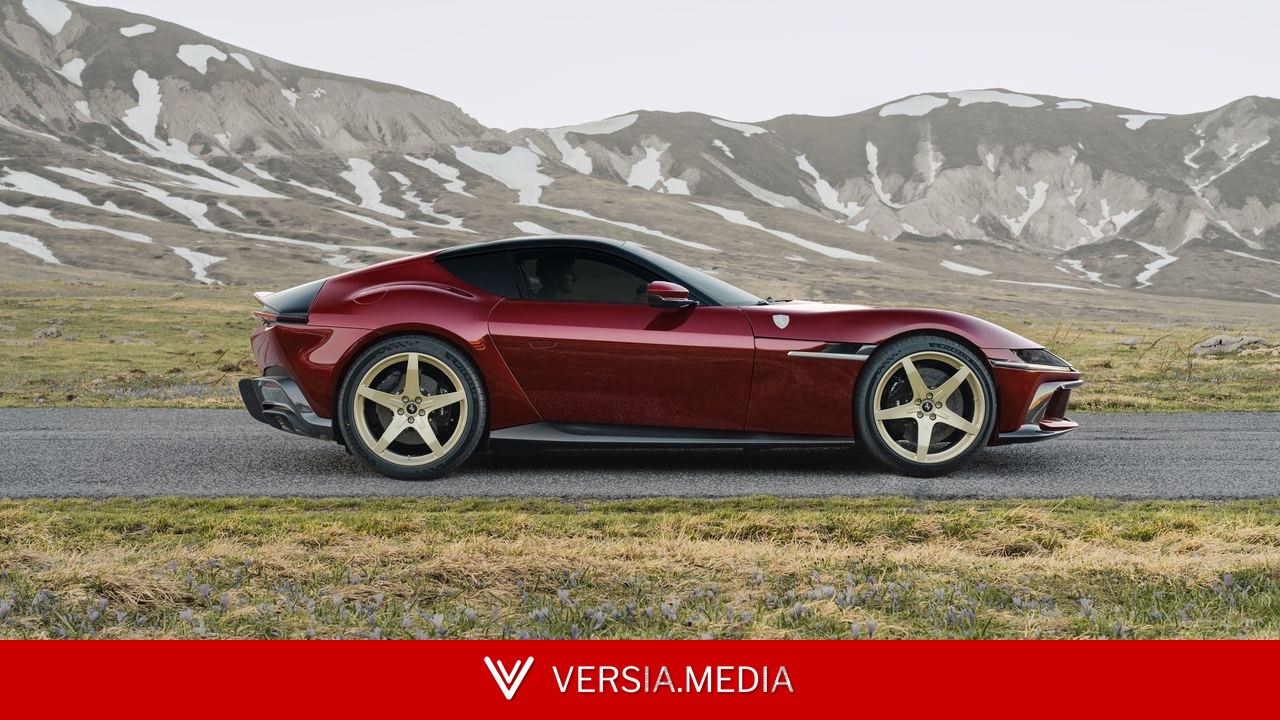
Ferrari engineered the feel of a gated manual without replacing its dual-clutch gearbox. Here’s how it works.
See All 23 Photos 23
We’ve entered the age of the blue pill automobile. First, Mercedes-AMG launches an electric car that makes you think you’re driving a rumbling, thundering V-8 . Except you aren’t. And now Ferrari has launched a car with a stick shift and clutch pedal that makes you think you’re physically controlling the gears in its transmission. Except you aren’t. That car is the Ferrari 12 Cilindri Manuale. If you believe the only proper Ferrari is a Ferrari with a V-12 engine and a traditional manual transmission, it’s been designed and engineered to let you believe what you want to believe.
0:00 / 0:00
Launched in the shadow of the the controversial Luce , the form of the 12 Cilindri Manuale is comfortingly familiar, but like the Luce, it’s also a very different sort of Ferrari. Maranello has always been focused on building cars with engineering and technology that deliver maximum performance, both in a straight line and around corners. Even the Luce hews to this core philosophy. But the 12 Cilindri Manuale is a Ferrari that sacrifices some of that ultimate execution in the name of entertainment. This is a limited edition iteration of Ferrari’s flagship 12 Cilindri grand turismo whose headline technology makes it slower .
See All 23 Photos 23
The Manual Is Back—Kind Of
Maranello openly admits the decision to develop a physical shifter and clutch pedal that allowed 12 Cilindri Manuale drivers to control the car’s dual-clutch transmission was made purely in response to customer demand. Replacing the 12 Cilindri’s slick eight-speed dual-clutch transmission (DCT) with a conventional manual was a nonstarter, however. Not only would that have required a wholesale rework of the car’s floorpan, but there were no conventional manuals that could handle the 818 hp and 500 lb-ft of torque pumped out by the screaming V-12 under that long, lovely hood.
Instead, a small engineering team headed by Ferrari’s powertrain project engineering lead Valentin Marguet focused on developing a traditional mechanical interface— shifter and clutch pedal—that through a combination of servos and software actuated the gearsets and clutches in the DCT. “I see it as a layer on top of the DCT,” said Marguet, who spent five years working on the development of that transmission, which made its production debut in the SF90. “I knew I had to bring back the mechanical experience while using what the DCT was offering in the best way.”
Marguet and his team thus spent a lot of time and effort working with Ferrari’s chief development test driver Raffaele de Simone evaluating manual transmission cars from Ferrari’s classic fleet. The goal was not only to ensure the actions of both the shift lever and the clutch pedal felt totally analog, but also that they felt true to the Prancing Horse’s heritage—right down to the clack-clack-clack of the lever as it was worked through a modern version of the metal gate that has been a feature of Ferraris since the 1950s. “That mechanical layer is authentic,” said Marguet of the kinematic mechanisms that anchor the shift lever and clutch pedal.