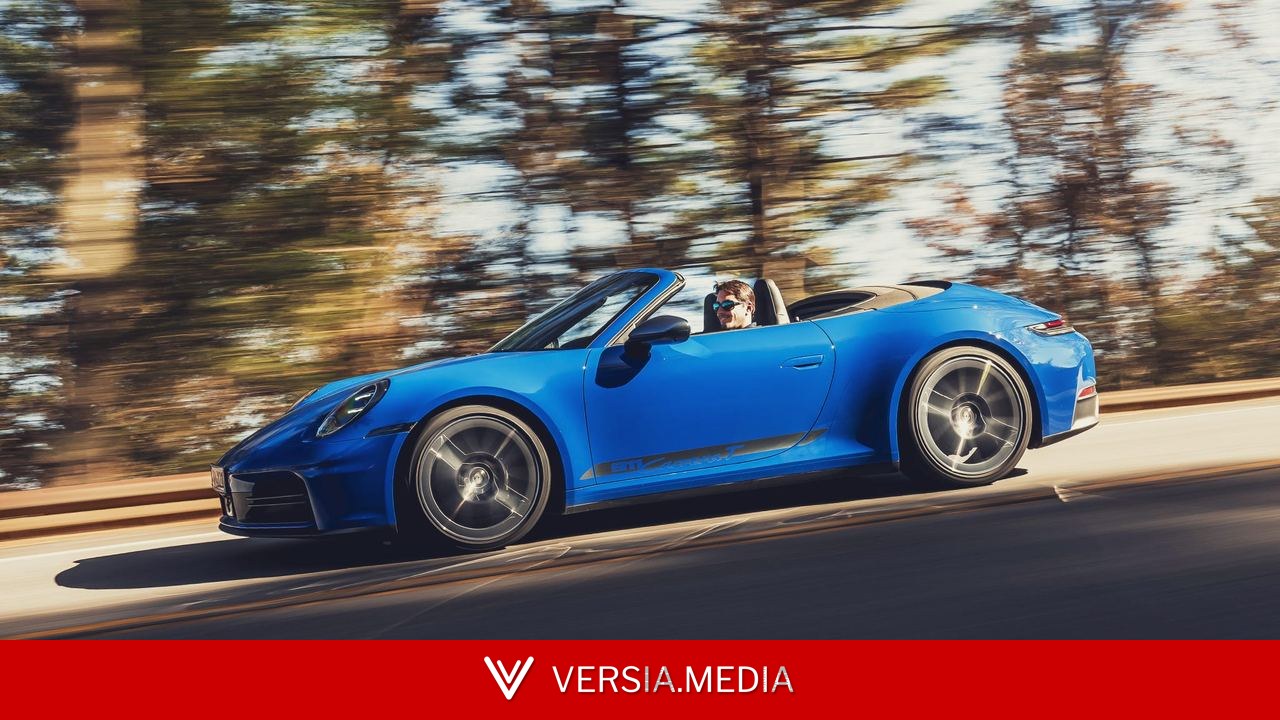
The roof may be gone, but Porsche’s clever engineering ensures the 911 T Cabriolet remains every bit the driver’s car enthusiasts expect.
See All 42 Photos 42
No roof = more fun
Manual gearbox is excellent
Minimal performance penalty
Some head-scratching ergonomics
Poor rear visibility
Slightly rough low-speed ride
You may have heard the internet has had its undergarments in a tangle over Porsche’s latest droptop, the 911 GT3 S/C . In fact, the perennial internet feud over these top-shelf 911s has become so white-hot that many often forget how good the more basic variants are.
0:00 / 0:00
And that got us thinking: The 911 Carrera T Cabriolet and GT3 S/C are currently the only two drop-top Porsche 911s available with manual transmissions. Seeing as we’re still waiting our turn to drive the S/C, we thought it’d be advantageous to find out how (or even if) the extra weight from the convertible top and reinforcements makes the 911 T Cabriolet less capable or engaging than the hard-top car—and if you’re able to feel the extra “floppiness” of the chassis.
See All 42 Photos 42
The age-old argument is that the convertible treatment almost always hinders vehicle dynamics. Trimming the roof sounds like a net positive, but the weight “savings” is almost always negated by the mass of the convertible top mechanism, along with the extra bracing needed to combat the decreased torsional rigidity of the unibody/chassis. This 911 T is no exception, as our scales measure it at a stout 163 pounds heavier than the hard-top 911 T—3,579 compared to 3,416. We should also note that this alters the weight distribution from 38/62 to 37/63 for the cabriolet.
We’ll get to the driving dynamics shortly, but it’s important to note that Porsche’s convertible top is a brilliantly engineered piece of equipment. It can deploy in approximately 12 seconds at up to 37 mph thanks to a three-element, magnesium-constructed lift mechanism—featuring a heatable glass backlite. That’s all well and good, but the question remains whether the added mass (that sits up high) and supposed extra chassis flex make any noticeable alterations to the car’s performance.
Mere mortals (like us) would be hard-pressed to feel the difference between both variants. We’ve now tested both cars and can categorically say the Cabriolet wasn’t significantly less capable. Allow us to give some context (using MotorTrend -specific test data):
992.2 Porsche 911 Carrera T
992.2 Porsche 911 Carrera T (Cabriolet)
0–60
3.9 sec
4.1 sec
60–0
99.7 ft
97.7 ft
100–0
272.6 ft
280.4 ft
23.4 sec
23.3 sec
See All 42 Photos 42