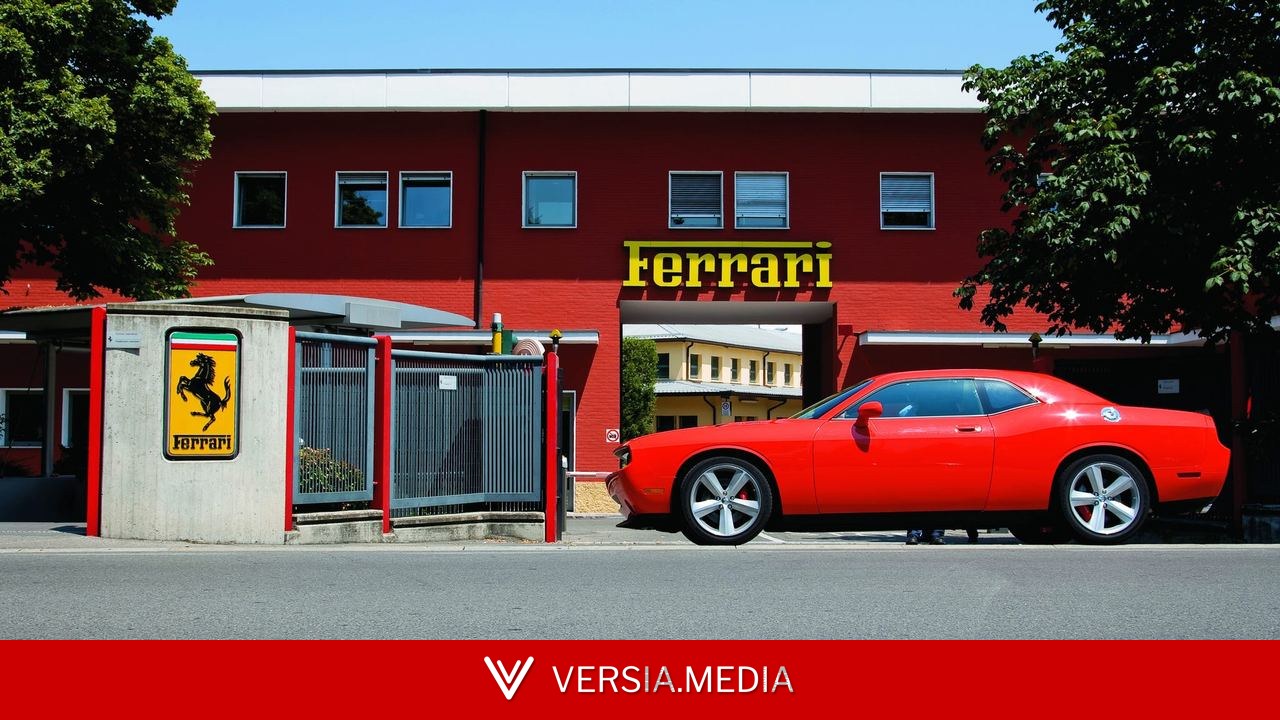
From 2007 to 2012, we hit the autobahn in Cadillac V models, a Dodge SRT, and the mighty Corvette ZR1. The results were memorable.
I was on an autobahn somewhere near Ramstein, Germany, in the late 1980s when I saw a boxy little Dodge Aries with U.S. Army Europe license plates wheezing along in the slow lane, shimmying and shuddering on its suspension at 70 mph. As locals in their garden variety Volkswagen Golfs and Opel Kadetts whisked past it at 85 or more, I remember thinking how cruel it was to be sent to a country that had the fastest roads on earth, that was the home of Mercedes-Benz, BMW, and Porsche—and Uncle Sam made you drive a crummy K-car .
0:00 / 0:00
To be fair, the late ’80s weren’t exactly a golden age when it came to desirable American automobiles. The Ford Taurus SHO was the nearest thing America had to a fast sedan, but it was 60 hp down on an E28 BMW M5 and drove the front wheels, not the rear. By the end of the decade, Chevrolet’s C4 Corvette had finally been given a decent six-speed manual transmission to replace the awful Borg Warner “4+3,” and it could hit 150 mph. But it still looked cheap and rode like a Conestoga wagon, which made it slow and cumbersome on a bumpy road. The Fox-body Mustang 5.0 was a ride on the mild side, nowhere near as fast or as accomplished as the V-8-powered Holden Commodores I was testing back in Australia at the time.
Only the Buick Regal GNX , a blocky, darkly sinister Darth Vader coupe with a 3.8-liter turbocharged V-6 that General Motors said developed 276 hp but probably pumped out closer to 300, really quickened the pulse. The GNX could beat a Ferrari Testarossa to 60 mph and ran the quarter mile in a tick more than 13 seconds, though it turned into a wobbly mess if you threw any corners into the equation. Buick only built 547 of those cars in 1987, a final hurrah for the live-axle, rear-wheel-drive G-body platform that had been designed in the mid-1970s. Its moment of madness over, Buick switched the Regal to the new front-drive W-platform for 1988 and banished any thought of building another muscle car from its corporate mindset.
By the time I joined MotorTrend in August 2004, American muscle was on the way back, a swag of hot and exciting new cars previewing a Detroit powerfest we hadn’t seen since the glory days of the 1960s. Our February 2005 print issue’s cover featured a showdown between the 425-hp Chrysler 300C SRT8 , the 400-hp gen-1 Cadillac CTS-V, and the (Australian-engineered, Holden Monaro–based) 400-hp Pontiac GTO, as well as a first look under the skins of the 500-hp C6 Corvette Z06 and the 500-hp Dodge Viper GTS. “American muscle is back, and it has definitely changed for the better,” I wrote in my editorial column. The coverline wrote itself: “The Power Issue!”
This new wave of American muscle kicked off a paradigm shift in Detroit. These were cars that not only were fast in a straight line but also had the suspension and brakes, the steering and tires, that got them through corners at speeds the guys who built SS454 Chevelles and Dodge Hemi Daytonas and Boss 429 Mustangs could have scarcely imagined possible. Old-school American muscle had been all about the quarter mile; new-wave American muscle promised something different: performance that was more than one dimensional. But could it really handle a flat-out run on an autobahn and a rapid rush up and over a winding Alpine pass, the driving environments that had spawned cars like the Mercedes-Benz E55 and the BMW M5? Visions of that old K-car swirled in my head. I had to find out in a variety of these new offerings.