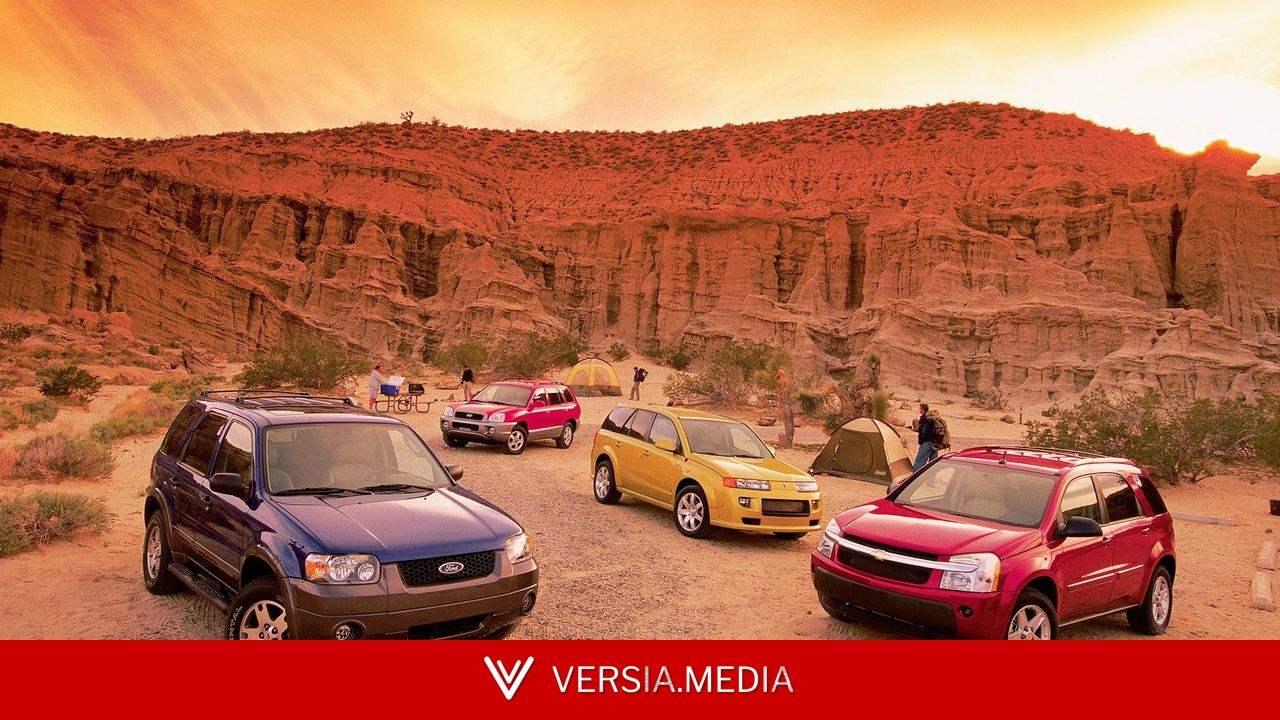
The quickest SUV impressed on pavement, but a desert camping trip revealed what mattered most.
See All 37 Photos 37
[ This story originally appeared in the August 2004 issue of MotorTrend with the headline "Gather ‘Round the Campfire." ] Looking for a sport/utility small enough to thread through parking lots without nasty scraping sounds, yet big enough to haul everybody off for a camping trip without pressing them into sardines? And enough pluck to pick through 8 a.m. traffic, too? Who do you think you are? Goldilocks?
0:00 / 0:00
Actually, there's a corner of the sprawling population of SUVs that might be, well, just right after all. It includes the facelifted 2005 Ford Escape XLT Sport 4WD with a V-6, a steady player that's just what its exterior design purports it to be—a steel and glass incarnation of a sprightly mountain goat; the aging but value-intense Hyundai Santa Fe 4WD GLS, rejuvenated by a new 3.5-liter V-6; and Saturn's VUE AWD Red Line, itself renewed via a new-for-2004 trim and suspension package, plus a serious-business 250-horsepower, 3.5-liter Honda-built V-6.
And if you're not confused enough already, we have the all-new (but VUE-based) Chevy Equinox AWD LT, powered by a 3.4-liter V-6 built in China. China? A Ford, a Korean, a Japanese engine in a brand named after a giant planet, and a Bow-Tie American employing an engine made in the land of The Great Wall. This is starting to sound like a Henny Youngman "four-cars-walked-into-a-bar" joke.
See All 37 Photos 37
To find out which would deliver the punchline and which the knockout punch, research demanded we probe their on-road performance, soft-road escapades, and, yes, their light-camping suitability. We ventured north into California's desert hinterlands to deploy tents, eat frozen lasagna blackened in its own tin atop a roiling fire, tell (or make up) road-trip stories, and otherwise rough it at the Red Rocks Campground located along Route 14 northeast of Mojave. Then, on to the eerie WWII Japanese internment camp of Manzanar, a stark juxtaposition of Asian-roofed stone guard gates and snowfrosted Sierra peaks. It was a scene you could sell as a postcard from Tibet.
There were rocky trails we scaled easily and some we carefully backed down after one too many klunks underneath. We even drove a quarter of a mile into a spooky old abandoned mine (cool!)—which we absolutely will not locate for you because it's our secret now. Everything else, however, we're happy to divulge.
See All 37 Photos 37
4th Place: 2005 Ford Escape
Parked before Red Rocks' eroding cliffs, the flinty Ford Escape could be a mechanical incarnation of wiry old Henry Ford himself, quietly pondering barren vistas, a twig slowly twisting in the corner of his mouth.
Actually, if Mr. Ford were alive today, we suspect he'd rather like the Escape. His favorite car was, of course, the do-anything, go-anywhere Model T, a square-deal machine that once was even driven down the Capitol steps as a publicity stunt. Our 2005 Escape could easily do the same (though it would likely wind up in Guantanamo before you could say Patriot Act).
So what has lowered it into the depths of fourth place?
An accumulation of niggling nickel-and-dime demerits rather than any calamitous catastrophe. Little stuff, like the chintzy-looking chrome-bezeled speedo and tach cluster, the cog-box's minimalist four instead of five ratios, and the engine's rough commotion accelerating under full-throttle.
On paper, the V-6's 200-horsepower figure would appear to make it a strong contender—indeed, it's second only to the Saturn VUE's halcyon 250. But further reading finds that its sub-three-liter displacement and low(ish) torque value (193 at a relatively high 4850 rpm) completely undermine things, resulting in acceleration that seems like a perpetual uphill battle. Additional culprits are those widely spaced transmission ratios, co-conspirators in making the Escape our quartet's solitary member not to make the 10-seconds-to-60-mph cut. Consistent in braking and going, it's the lengthiest emergency-stopper, too (139 feet).
On sinewy lanes, however, the Escape is strangely pleasant to handle. Not because it corners well—in fact, angling the wheel produces a virtual goulash of roll and groggy re-directioning. Rather, amid the lurid dynamics, the Ford feels as if it rotates—pirouetting is too dainty a word—about a vertical axis that's centered at, well, you. It's as if you were standing in a child's cardboard-box vehicle that you just picked up and rotated. It gives the Escape a peculiar sort of I'm-on-your-side handling friendliness that the others, even the comparatively Formula One-like Saturn, don't share. At speed, the interior is a noisy brew of road rumble and aerodynamic whoosh, but the Escape provides a reasonably supple ride given its tallish proportions.
When the asphalt gives way to aggregate not coalesced by sticky tar, the little Ford becomes something of a scrambling Escape artist, avoiding pitfalls at least two of the others regularly stumbled into. When we'd occasionally encounter a debris field of rocks pretending to be a road ("Gee, there's a line here on the map... "), the Ford felt eager to press on when its rivals seemed inclined to lie back, tabulating the pros and cons of the situation. Of the rest, only the Hyundai even approached the Ford's rock-climber mentality.
As an aside, the undercarriages of our four test vehicles recorded a sort of unintended scorecard of their relations with the planet's crust, noting each encounter, scrape by painful scrape. On hands and knees, we'd occasionally inspect these records, and, surprisingly, the Escape's was consistently scratchless. Luck? No such thing.
In the rear, the cargo bay stands apart from the others for its sheer, back-to-basics simplicity. Whereas the aft quarters of the GM vehicles are busy with overthought folding plastic storage aids and parcel organizers you have to assemble, arrange, or otherwise tinker with, the Ford has just flat carpet. What a novel idea: You can put stuff in there and arrange it as you'd like. Also, when the rear seatbacks are folded, the extended floor lies perfectly flat, ideal for sliding multiple boxes into the back without lumps in the floor snagging them.
At a base price of $26,030, our Escape XLT Sport 4WD came standard with the V-6 engine, but also included an optional power moonroof ($585), added front side airbags ($425), and a leather comfort group ($575) that wrapped the steering wheel and seating surfaces.
Climb atop those seats, and you'll discover that the view through the big windshield is airily uncluttered, framed only by two welcome grab handles on the A-pillars. But the dash design below it led to arguments. Some felt it was elementally purposeful; how a manly-man's sport/ute interior ought to look. Others, more secure with such issues, thought it dull as toast and dotted with low-ball buttons and knobs. An example of the Ford's more utilitarian taste is the front-passenger airbag's unadorned fitment into the dash molding. You could fit a quarter's edge into the gap outlining it. In the other vehicles, this passenger bag is integrated so well it's almost hard to find. And, um, this is the Escape's new-for-2005 dash.
The touch-up job done to the nose, like that to the dash, is subtle (a line here, a bevel there); the biggest difference is the welcome addition of crisp-looking reflector headlights replacing the Escape's previously foggy-eyed sealed-beam trace.
Park the rectilinear Escape and lanky new Equinox next to each other, and they could be designed a decade apart. Dearborn's SUV design DNA has been replicated maybe a bit too often, making the Excursion, Explorer, and Escape look almost like the same vehicle, just at different distances away. However, there's something friendly, approachable, and genuine about this iconic SUV appearance that Americans evidently resonate with—and are continuing to buy in droves.