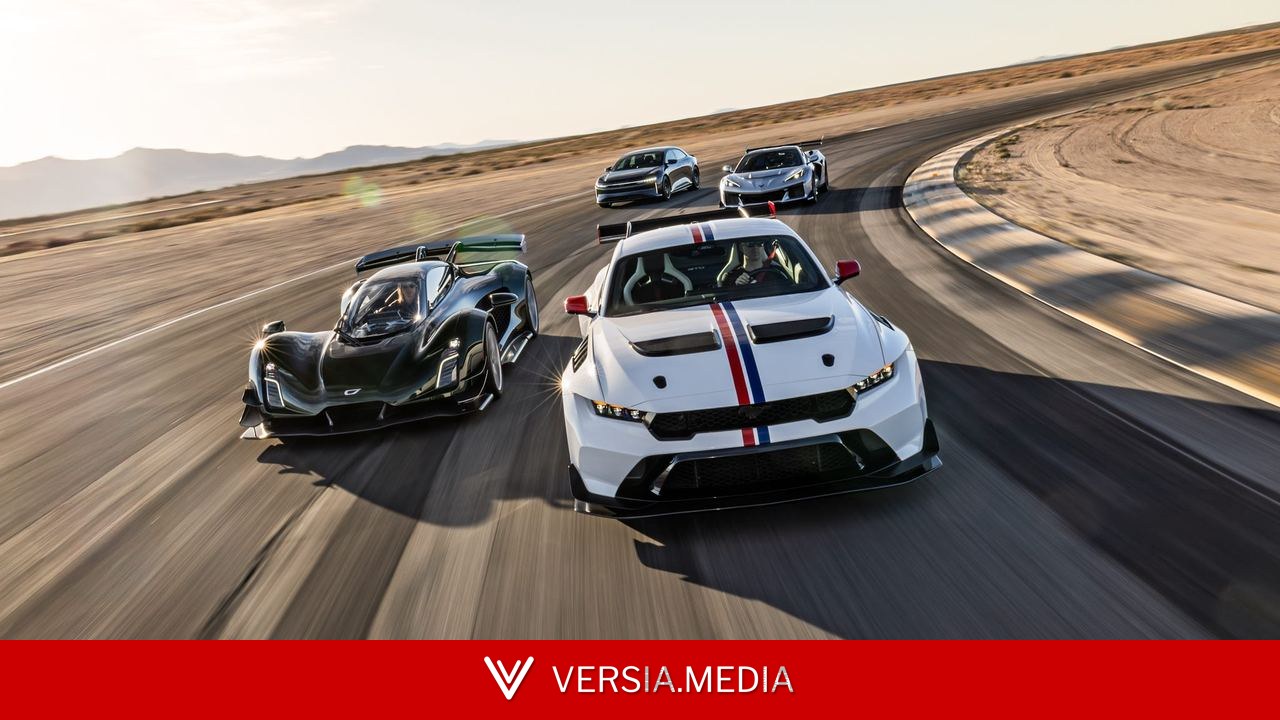
The Corvette ZR1X, Mustang GTD, Lucid Air Sapphire, and Czinger 21C prove America’s best performance cars are better than ever.
See All 58 Photos 58
We’re 250 years into the grand experiment known as the United States of America. In that time this country has become known as one populated by industrious and generally optimistic people, with the belief a person can achieve their dreams via hard work, determination, and community. We’re restless, too, not afraid of exploring the unknown, whether it be found on Earth, the moon—or beyond.
0:00 / 0:00
Similarly, the automobiles America is most known for are the ones most associated with work and exploration. American automakers invented functional and practical pickups and SUVs, all of which remain hugely popular. And even though the first sports cars and supercars originated overseas, meaning the idea wasn’t “ours,” we’ve built some great ones, too. But this isn’t about looking back on the past; we’re more curious about now and what’s next. What is the state of the art? What are America’s best performance cars in 2026? And what does it all tell us about what our future holds?
To find out, we first assembled four cars we think best represent contemporary American-made performance and spent a week with them on the track at Chuckwalla Valley Raceway, on the road, and even on a U.S. Air Force runway.
See All 58 Photos 58
The Traditional: Ford Mustang GTD
The muscle car is the type of performance automobile most associated with America, and the 2025 Ford Mustang GTD faithfully follows in that tradition . Born from the idea of building a streetgoing version of the Mustang GT3 race car—admittedly not an original conceit—the GTD blends muscle car provenance with 21st century motorsport innovations.
Technically, the GTD journey isn’t all American. Every Mustang begins its life in Flat Rock, Michigan, where a GTD’s body-in-white is plucked off the line and shipped to Multimatic in Ontario, Canada, where the hot rodding begins.
There the rear subframe is modified to accommodate a new eight-speed twin-clutch automatic transaxle, freeing space for Ford’s 5.2-liter Predator V-8 under the hood. Following the familiar muscle formula of boring out a smaller engine for more juice and then supercharging it, the GTD produces 815 hp and 664 lb-ft of torque. Unlike most muscle cars, this is the least interesting part of the car.
See All 58 Photos 58
Instead, it’s what’s going on underneath and outside that makes the GTD extra special. In addition to the transaxle and associated radiators in the “trunk,” this Mustang sports Multimatic’s DSSV suspension, which pairs electronically controlled spool-valve dampers with two coil springs, one for track work and one for the street. Track mode engages a hydraulic ram that drops the Mustang closer to the ground by more than an inch and a half. The subsequent reduction in frontal area, an aggressive GT3-style aero kit, and an active drag- reduction-system-equipped rear wing add about 15–20 mph to the car’s top speed, which is officially 202 mph.
Other changes: steamroller-width Michelin Pilot Sport Cup 2 R tires (which all but the Lucid featured), carbon-ceramic brakes, traction control that allows drivers to dial in how much or how little help they’d like, and extensive carbon fiber to keep its 4,400-pound curb weight from ballooning any higher.
See All 58 Photos 58
Amazingly, you don’t really notice those pounds behind the wheel. The GTD is the most impressive Mustang we’ve ever driven. It’s familiar, yet it inspires confidence and feels balanced in a way no previous Mustang has achieved. The suspension and chassis are the stars here; they respond to inputs in a way that, as ridiculous as this sounds, makes this porker feel like a much smaller, lighter car. A reasonably good driver can easily rotate the rear end and precisely point the nose seemingly at will.
The rest of the supporting package is equally great. The car brakes like it could stop a fully loaded Air Force tanker, and its steering only gets better as you put more heat into the tires. Bury your foot in the throttle, and you’re greeted by a throaty bellow out the back end, accompanied by quick shifts and the supercharger’s whine. The GTD doesn’t feel straight-line fast among this cohort, which speaks more to the insanity of the group: At 2.7 seconds to 60 mph and posting a lap time at Chuckwalla just 4.17 seconds off the quickest car’s pace, it is indeed an incredibly quick and fast car.
More than numbers, however, the GTD makes us feel like we never want to stop driving, capturing an essence only the best performance cars offer—that nirvana, a greater sense of understanding about both the machine and its driver, is just a bit farther down the road.