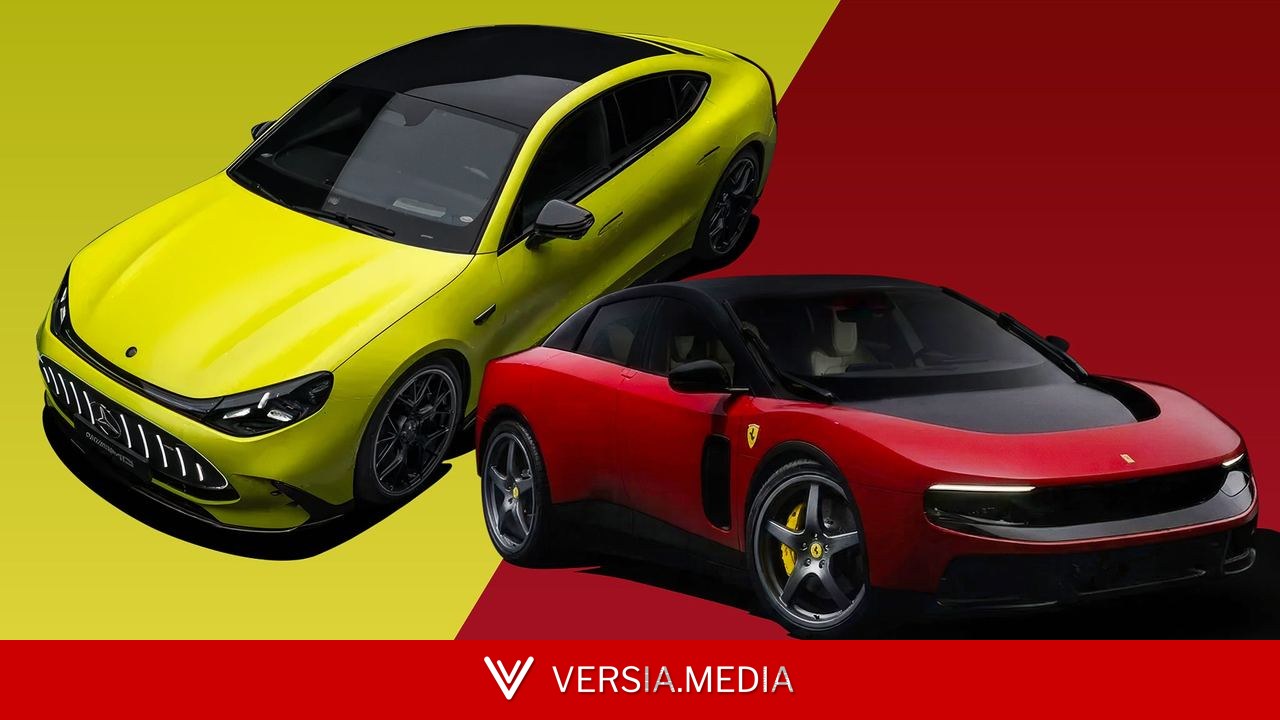
The spec sheets show a lot of similarities. But they’re very different cars.
The recent reveals of the Ferrari Luce and Mercedes-AMG GT 4-Door Coupe sent the interwebs into overdrive, with clickbaiting social media mavens all over the world—the majority of whom have yet to see either car in the metal—firing off blistering critiques about their design and technology. I’ve been to the tech previews, interviewed senior execs at Ferrari and Mercedes, and attended the launch events of both cars. I’ve driven a prototype of one (I can’t reveal which yet) and ridden in a prototype of the other. Very few people have been as up close and personal as I have with both cars. So, yes, I have some thoughts.
0:00 / 0:00
Make no mistake, both the Luce and the GT 4-Door Coupe are epochal machines. The first production electric vehicles from Ferrari and Mercedes-AMG (the nine or so hand-built SLS AMG Electric Drive coupes sold in 2013 don’t count), they ask existential questions of both automakers.
Mercedes-AMG GT 4-Door frunk.
For some aficionados, they are questions that ought not to be asked of brands that made screaming V-12s and thundering V-8s famous. But for both Ferrari and Mercedes-AMG, each contemplating a future where electric vehicles will become ubiquitous, they simply had to be built. “Should we get to the point where the new [electric vehicle] technology finally unseats the incumbent technology, we need to be in the position not to miss that point,” Mercedes chairman Ola Källenius said. “The Ferrari Luce is not a response to change,” Ferrari chairman John Elkann insisted. “It is a decision. A deliberate decision to lead what comes next.”
Both the Luce and the AMG GT 4-Door Coupe are the products of companies that have long developed cars at the cutting edge of the performance envelope, and, at a fundamental level, they’re strikingly similar. Both are all-wheel-drive four-doors of roughly the same size. At 200.6 inches, the Mercedes is 2.8 inches longer overall than the Ferrari and has a 3.2-inch-longer wheelbase, while the Luce is 1.6 inches wider and 5.2 inches taller than the GT 4-Door. Each has more than 1,000 horsepower and is built on a skateboard platform anchored by a liquid-cooled high-performance battery pack and an 800-volt electrical architecture that enables fast deployment and fast charging. Each has complex software systems that deliver precise control of vehicle dynamics via a wide array of adjustable digital tools for enthusiast drivers to exploit.
But they are quite different beasts. Here’s how they stack up.
Ferrari Luce platform and powertrain.
Luce vs. AMG GT 4-Door: Powertrain
The Luce has a four-motor powertrain developed entirely in-house at Maranello. The radial-flow permanent synchronous magnet e-motors have their magnets arranged in what is called a Halbach array, a setup used in Ferrari’s F1 powertrains that directs the magnetic flux toward the stator to maximise torque density. As the motors are designed to spin to very high revs (the front pair at up to 30,000 rpm and the rear pair at up to 25,500 rpm), their magnets are held in place by thin, ultra-light, and ultra-strong carbon-fiber sleeves, not the least because at maximum revs the centrifugal force acting on each 3-ounce magnet in the motors is equivalent to 3 tons. The two e-motors at the rear axle each develop a maximum of 416 hp and 262 lb-ft of torque, while the two e-motors up front each develop 141 hp and 103 lb-ft of torque. Total system output is 1,035 hp and 730 lb-ft.
The AMG GT 4-Door is powered by three axial-flow electric motors, one at the front axle and two at the rear, developed by British-based Mercedes-Benz subsidiary Yasa Ltd. Unlike the radial-flux motors in the Luce, which have a tubular stator inside a tubular housing, the axial-flux motors feature a disc-shaped stator at their center that enables the magnetic flux to flow parallel to the motor shaft rather than perpendicular to it, dramatically improving efficiency. Axial-flux motors are 67 percent lighter and 67 percent smaller than comparable radial-flux motors delivering three times the power density and twice the torque density, Yasa CEO Jörg Miska told us. And the numbers back him up: In the top-of-the-range GT63 model, that powertrain delivers a total system output of 1,153 hp and a gargantuan 1,475 lb-ft of torque.