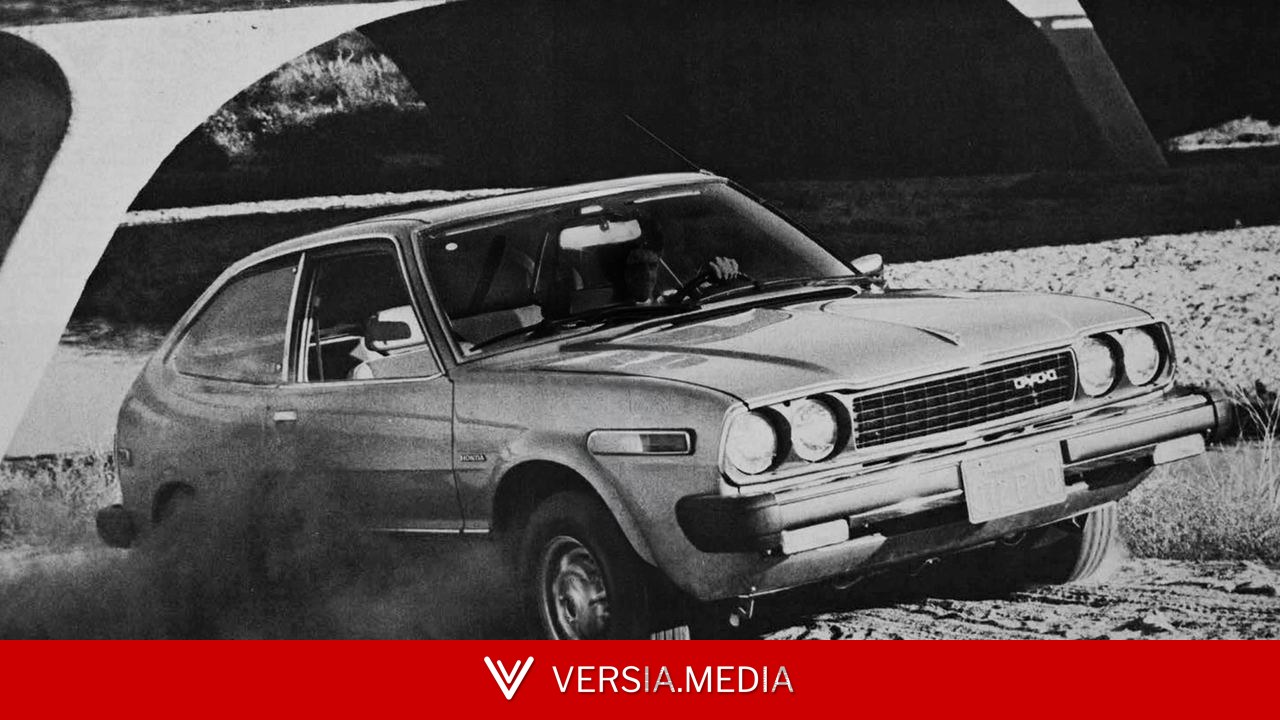
The first Honda Accord delivered a combination of value, comfort, and efficiency that impressed our testers.
See All 19 Photos 19
[ This story originally appeared in the September 1976 issue of MotorTrend with the headline "Honda Accord: Road Test." Honda recently celebrated the 50th anniversary of the Accord and we pulled this from the archives to help mark the occasion. ] In the seven short years since Honda began selling automobiles in this country, it has managed to climb to the number four position among importers.
0:00 / 0:00
Although the first cars sold here, the 600 sedan and coupe , were good in their own way, the Civic is the car that "made" Honda in the States. Unfortunately, the Civic was smaller than some of the competition (notably the VW Rabbit), and Honda believed that a bigger car should be developed to supplement the Civic. The result is the new Accord.
See All 19 Photos 19
More Car for the Money
The Honda Accord got its start in 1972, when Honda began development of a larger-than-Civic-sized car, which was given design number 671. By the fall of 1973 the final clay models had been completed. The engine to be used, a long-stroke version of the Civic's 1.5-liter four, would displace 1.6 liters in the 671. By January of that year, all testing of prototypes had been completed and production of the new car had been okayed. The name Accord was selected about this time, following the recent affinity the Japanese have shown for products with French names. (At this time there are four cars, three motorcycles, two color TVs and six chocolate bars with French names being sold in Japan that are all Japanese-made.)
Aside from the engine and transmission, there is little interchangeability of parts between the Accord and the Civic. Both of the cars have MacPherson strut suspension all the way around, but the strut cartridges are the only parts in common.
See All 19 Photos 19
The Accord's powerplant is a 1600cc, cast-iron, in-line four with a Honda CVCC-design aluminum cylinder head. (The CVCC principle is to use a rich mixture in a precombustion chamber to ignite a much leaner mixture in the main combustion chamber.) The engine is undersquare, with a 2.91-in. bore and long 3.66-in. stroke, but it still manages to rev quite freely up to its 6500 rpm red zone. Like many Japanese cars, however, it has an irritating habit of holding rpm instead of letting the revs drop on deceleration.
Cold starting the Accord is a snap, with the engine usually catching on the first turn of the starter. On chilly mornings the choke has to be pulled out to its second detent, and after some minor stumbling for the first half-mile or so, the SOHC four pulls well without any hesitation.
See All 19 Photos 19
Hot starting the Accord is not such a simple matter. The carburetor is mounted directly over the exhaust manifold, so if the engine is hot, fuel may boil out of the carb float bowl. The percolated gasoline comes to rest in the intake manifold, just waiting to be sucked into the combustion chamber when the starter is cranked over. One staffer calls this "Honda's self-flooding carburetor." It has been a problem on the CVCC Civics, but not to the extent it was on the three Accords we drove.
The standard transmission is a 5-speed manual box, with the Hondamatic 2-speed semiautomatic transmission available as an option. The rod-operated gearchange is light in its action and more precise than usual for a transverse-engined car.
One odd thing about the transmission is that there are no direct gears: 1 st , 2 nd , and 3 rd are all indirect, while 4 th and 5 th are both overdrive. With such tall gearing, fuel mileage figures are superb, but the Accord is seriously handicapped in power in the top two notches. On our 73-mile test loop of urban/freeway driving, the Accord returned 36.2 mpg, and it is rated on the EPA's highway cycle at 44 mpg. In these days of resource awareness, we think that's a reasonable trade-off between performance and fuel economy.