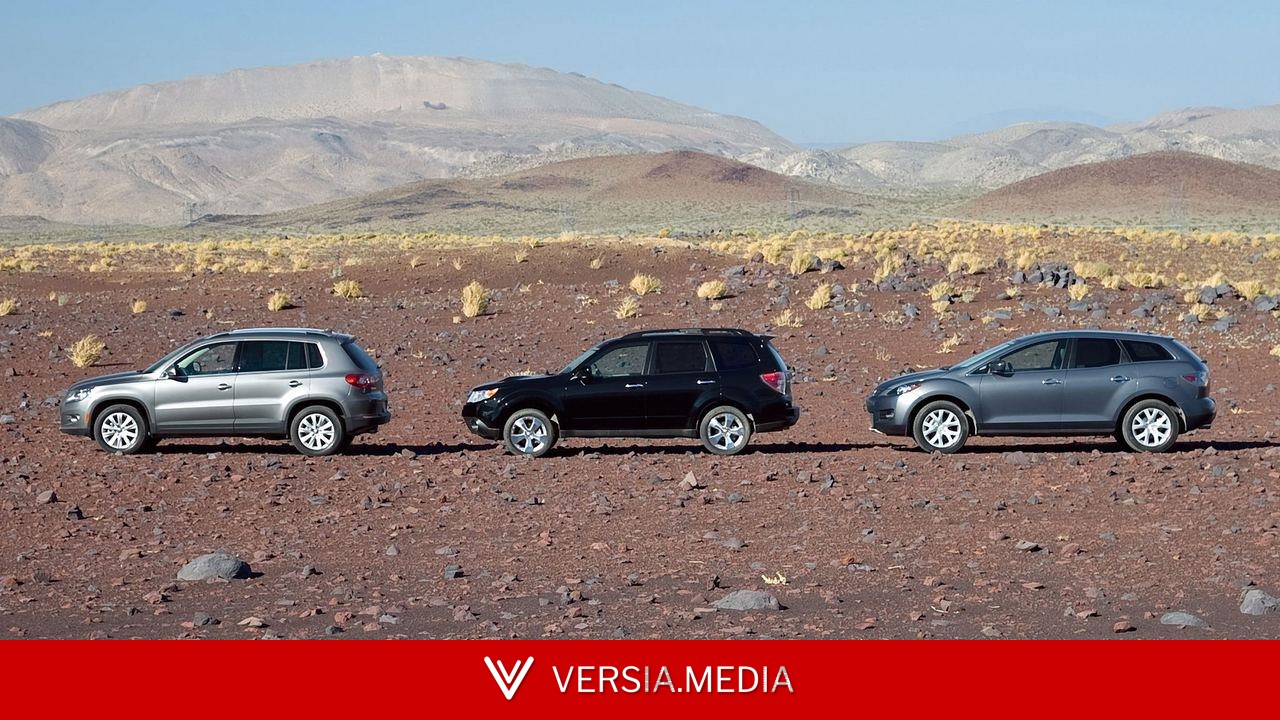
The Mazda delivered the most driving fun, but one turbo crossover simply did everything better.
See All 19 Photos 19
[This story originally appeared in the September 2008 issue of MotorTrend with the headline "TurboChargers."] Upon initial review, Volkswagen 's timing couldn't have been more perfect. Just as gas is approaching a Lincoln per gallon, the German brand introduces the Tiguan, its first compact crossover in the U.S. and one with a miserly 2.0-liter engine that achieves combined fuel economy of up to 21 mpg. Prospective buyers of mid- and full-size sport/utilities , who know deep down that a smaller vehicle will suffice, are taking notice. In its first month of sale, for instance, the Tiguan enticed 179 more buyers than did its larger, thirstier sibling, the Touareg. And with no end in sight for the rise of fuel costs, the discrepancy is bound to become more severe. After all, who really needs a V-6 or V-8 engine, certainly when a four-cylinder exhaling through a turbocharger delivers horsepower and torque figures at or above 200 and gas mileage that hovers around 20 mpg?
0:00 / 0:00
With that in mind, we gathered the all-new 2009 Vee-Dub, along with two of its turbo-four rivals-the equally new 2009 Subaru Forester XT and the formidable 2008 Mazda CX-7-equipped them in topline trim and with all-wheel drive, and took them on a 500-mile trip to Lone Pine, California, home of Mt. Whitney, the tallest peak in the Lower 48. Along the way, we evaluated the threesome over our hilly 40-mile test loop in Tehachapi as well as the rugged, dirt roads in Fossil Falls State Park in Little Lake. Naturally, we concluded the review with our usual battery of instrumented track testing. Which of these go-anywhere turbochargers performs best under pressure? Let's get spooled up.
See All 19 Photos 19
The Volkswagen Tiguan , in $33,630 SEL 4Motion guise, proves the priciest of the group, but does come loaded with leather trim, dual-zone automatic climate control, Dynaudio 300-watt stereo, 12-way power driver's seat, bi-Xenon headlamps, 18-inch alloy wheels (it's curious that our test vehicle had 17s, a fact VW chalks up to a factory oversight), and three options—$350 rear side airbags, $1300 panoramic sunroof, and $1950 navigation with backup camera—which ups the price to $37,230. Damn you, Euro! (So much for that perfect timing.)
Nevertheless, the Tiguan justifies its steep sticker, at least somewhat, with the group's richest cabin. "Nicest interior," says senior editor Ed Loh, adding, "It looks actually designed, rather than assembled from a parts bin like the Subaru's." Editor at large Arthur St. Antoine feels the same: "Overall, impression is of high-quality materials and stylish design. The Tiguan looks expensive (and is)." Moreover, the VW boasts the most rear headroom as well as useful features not found in the others, namely an SD memory-card reader for the audio system, a height-adjustable center armrest, a driver-side glovebox with five slots for coins, and a mini-jack auxiliary input (the Forester's aux input is of the RCA variety).
The Deutschland-built Tiguan, not surprisingly, offers a very Teutonic ride: firm enough for responsive moves yet supple enough for everyday liveability. While the standard-but-absent 18-inch wheels might've starched the ride a smidge, they likely would've sharpened handling a bit, too, although the 17s performed admirably, providing quick turn-in and commendable grip (0.81g lateral acceleration). That said, the electromechanical steering feels too light and overboosted at low speeds, a sharp contrast from the well-weighted helm of the Mazda.
Despite its compact dimensions, the Tiguan weighs just south of 3800 pounds, over 300 porkier than the Forester. That scale readout, along with its weakest-of-the-bunch 200-horse engine, results in the slowest acceleration numbers-0 to 60 in 8.2 seconds and the quarter mile in 16.2 at 85.7 mph. Still, we love VW's ubiquitous 2.0T mill, which spins freely and euphonically and unleashes 207 pound-feet of peak torque at just 1700 rpm.
"With more than a 20 percent premium over the Forester, the Tiguan may experience Passat-like sales in the States," opines Loh. "Huge outside of the U.S., where people are used to paying a premium for less performance and more style, but not so big in America." St. Antoine notes, "The VW, with its artful cockpit and premium look and feel, is easy to like, but you can't deny that it's the slowest and by a wide margin the most expensive." The Tiguan is an outstanding first effort, but too pricey to advance beyond third place in this test.