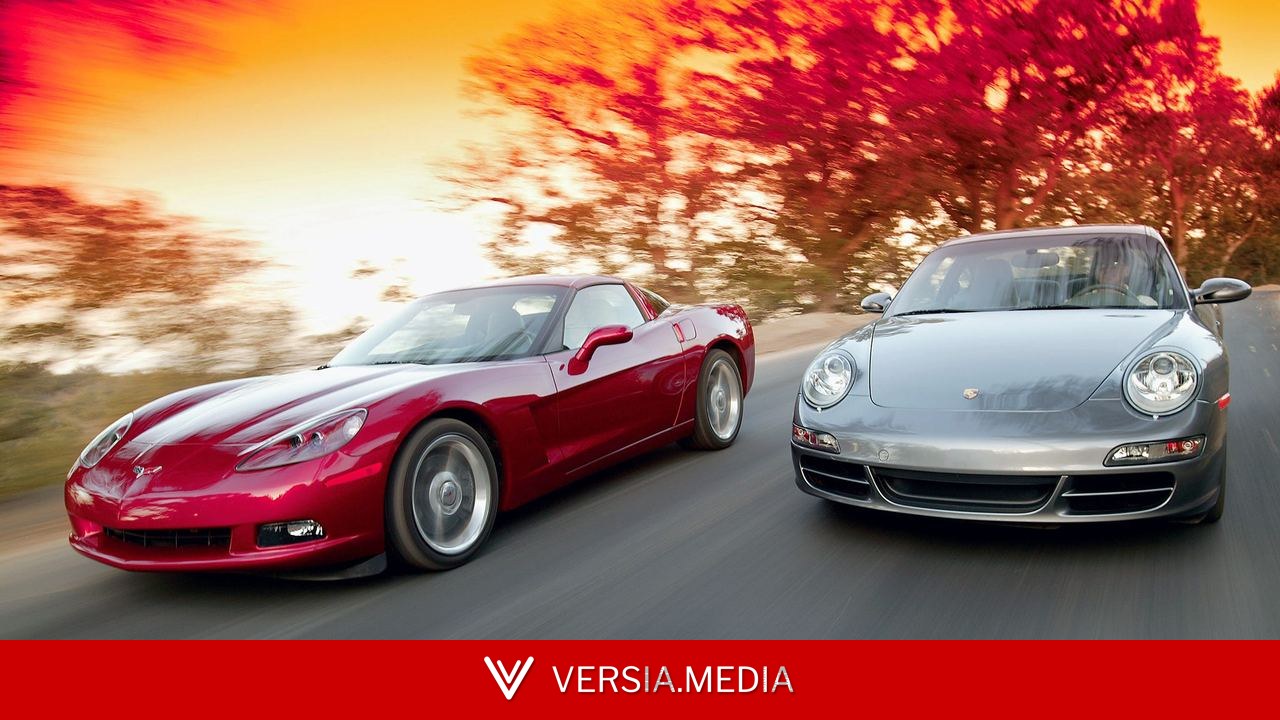
Two icons shaped entire generations of car enthusiasts. A 2005 showdown revealed just how far each had evolved.
Save
See All 17 Photos 17
Chevrolet Corvette and Porsche 911. They are kindred spirits. Survivors. They have endured oil crises and recessions, safety regulators and corporate blunders; they have defeated rivals on roads, tracks, and showroom floors; and they have recovered from occasional missteps—the awkward 964, the underwhelming L82—to reach the 21st century leaner, stronger, and more capable than ever. Each is a genuine sports-car legend. And like many legends, each is constrained by its past.
0:00 / 0:00
The Rivalry That Defined Sports Cars
These two have faced off many times over the past 40-plus years, but rarely has the competition seemed so balanced. Select the right versions, and they will produce identical quarter-mile times and lap Willow Springs racetrack within a second of one another. One achieves a top speed of 179 mph, the other 186 mph. They are even nearly the same size and weight—the 911 has expanded and gained mass over the years, while the Corvette, having swelled like Elvis during his Vegas years in the 1970s, has since shed size and weight, to the point where the C6 is actually one inch shorter, two inches lower, and 16 pounds lighter than the Porsche.
See All 17 Photos 17
Same Goal, Different Approaches
Ah, but that history... There is still no replacement for displacement in a Corvette, and the C6 roars with a 6.0-liter small-block V-8, featuring pushrods, just like in the 1950s. Porsche, meanwhile, steadfastly depends on a precisely engineered flat-six, mounted far behind the rear axle just like every 911 since 1963. Neither is exactly what you would anticipate from a 21st-century sports car.
Porsche calls its newly released Type 997 the "new" 911, but in reality it is a major overhaul of the eight-year-old water-cooled 996. Nearly everything—engine, transmission, suspension, brakes, interior—has been adjusted, refined, improved, or replaced. But Porsche also dedicated a significant portion of its development budget to deliberately changing almost every exterior body panel to make the car resemble the older 993 version from a decade ago, with round headlights and more sculpted rear fenders. It is beautifully done, but somewhat like a digitally restored Renoir. Depending on your perspective, new Porsche design chief Michael Mauer—the person who will style the next-generation 911, due in 2010—either has the simplest job in the auto industry or the most difficult.
There are lies, damned lies, and then there are statistics. Statistically, the new C6 Corvette is also a thorough reworking of an existing model. Chief engineer Dave Hill has been frequently quoted as saying 85 percent of the C6's mass and 70 percent of its part numbers are new. Whatever that means, it doesn't seem to matter as we cruise down Santa Monica Boulevard in the warm glow of another sunny L.A. day. We are in the new Corvette—and nobody has noticed. The C6 might be five inches shorter than the C5 and wrapped in tauter, tighter, more angular panels, but visually it is nearly identical—same wide rear stance with quad taillights and quad exhausts in the same positions, same scoop on the side behind the front wheel. Okay, the C6 has—gasp!—fixed headlights. But the small projector units sit in body-colored housings rather than shiny chrome bezels and are nearly invisible from a distance.
Under the skin, our metallic red Vette features the Z51 suspension upgrade, which provides stiffer springs and shocks, thicker stabilizer bars, and larger cross-drilled disc brakes front and rear for $1,495. You also get oil coolers for the engine, transmission, and power steering, along with different gear ratios—lower first, second, third, and sixth gears, plus a slightly taller fifth—for the Tremec T56 six-speed. The LS2 V-8 is unchanged from the standard C6, but with 400 horsepower and 400 pound-feet of torque, that is hardly a drawback. Other options include GM's all-knowing OnStar, XM Satellite Radio, and polished alloy wheels, and we still have change from $50,000. As always, the Corvette offers plenty of performance for the price.
Next to the Tommy Hilfiger flair of the Corvette, the 911 Carrera S has the expensive gray sheen of a Hugo Boss suit, and a price tag to match. The S increases the 3.6-liter, 325-horsepower engine of the standard $69,300 Carrera to 3.8 liters and 355 horses—oh, and costs you a stunning $9,800 more. But the extra money also gets you 19-inch wheels all around, minor cosmetic upgrades like white-faced instruments, and the Porsche Active Suspension Management system, which combines a 10mm-lower ride height with stiffer springs and electronically adjustable shocks. Our test car also includes the optional Sport Chrono Pack Plus, which is more than just a $920 stopwatch on the dashboard—activate it, and you will get sharper throttle response, higher rev limits, and more freedom from the stability and traction-control systems.