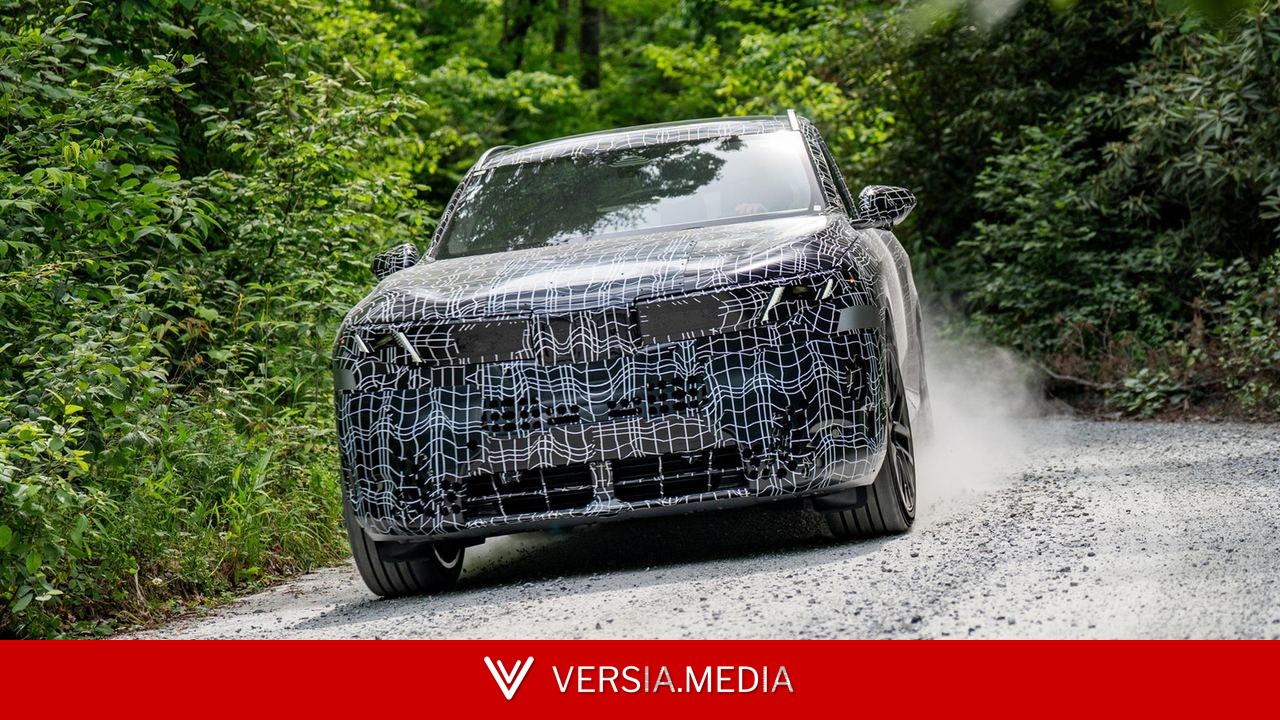
BMW’s top-selling SUV steps into a fresh chapter, now offering an electric powertrain option alongside significant technological advancements.
Save
See All 46 Photos 46
BMW’s original X model, the X5, debuted at the close of the 1990s. This South Carolina–manufactured SUV is set to enter its fifth generation later this year, and we recently test drove prototypes of the three powertrains that will kick off the 2027 BMW X5 lineup: two 3.0-liter turbocharged inline-six engines, enhanced with mild and plug-in hybrid systems in the 40 and 50e xDrive trims, and a fully electric iX5 60 xDrive. Here is what has changed:
0:00 / 0:00
Updated CLAR (CLuster Architecture)
The foundational elements of the X5’s existing MittleKLasse (MKL) CLAR structure have been reconfigured to extend the wheelbase by 2.4 inches and total length by 2.6 inches (width and height see slight reductions). It has been adapted to support either an underfloor battery pack paired with front and rear motors or the conventional configuration.
All front suspension attachment points are identical, as are the mounts for the rear suspension/differential carrier or the rear electric drive unit. The floorpan remains the same; the electric battery pack is still somewhat visible on the iX5 (standard air suspension lifts ground clearance when necessary), whereas the PHEV’s battery occupies the space beneath the rear seat and partially under the footwell, with its fuel tank positioned above the rear axle.
Chassis Components
Every X5 model will include adaptive damping paired with steel or air springs, while electromechanical roll stabilization and rear-wheel steering are offered as extras. A major change: previously concentric rear spring/damper assemblies are now separated, with dampers mounted just outward of the springs. (They stay concentric at the front.) This design increases air spring volume, enhancing comfort and supporting greater weight.
See All 46 Photos 46
An additional handling improvement: each new X5 variant comes with staggered wheel and tire setups, suited to the nearly neutral weight distribution and naturally rear-biased torque delivery across all models. Side-to-side torque distribution currently relies solely on brake intervention, but upcoming M variant(s) will likely alter this.
Powertrains
Worldwide, the X5 will debut with five powertrain options. The two not coming to our market include a diesel hybrid 40d xDrive and an M60e xDrive, which replaces the V-8 with a more potent (569-hp) B58 I-6 engine paired with our 50e’s PHEV system. Some regions may eventually see a hydrogen fuel cell version, and we would be surprised if a base rear-drive model, an M60e, and a V-8-powered M variant didn’t arrive here within a few years. For now, we receive a robust engine with a mild hybrid motor in the X5 40 xDrive (394 hp combined), and a moderately tuned engine assisted by a motor strong enough to propel the vehicle independently in the 50e xDrive (483 hp combined). The current performance leader is the iX5 60 xDrive, which delivers 245 hp from the front and 325 hp from the rear, totaling 570 hp.