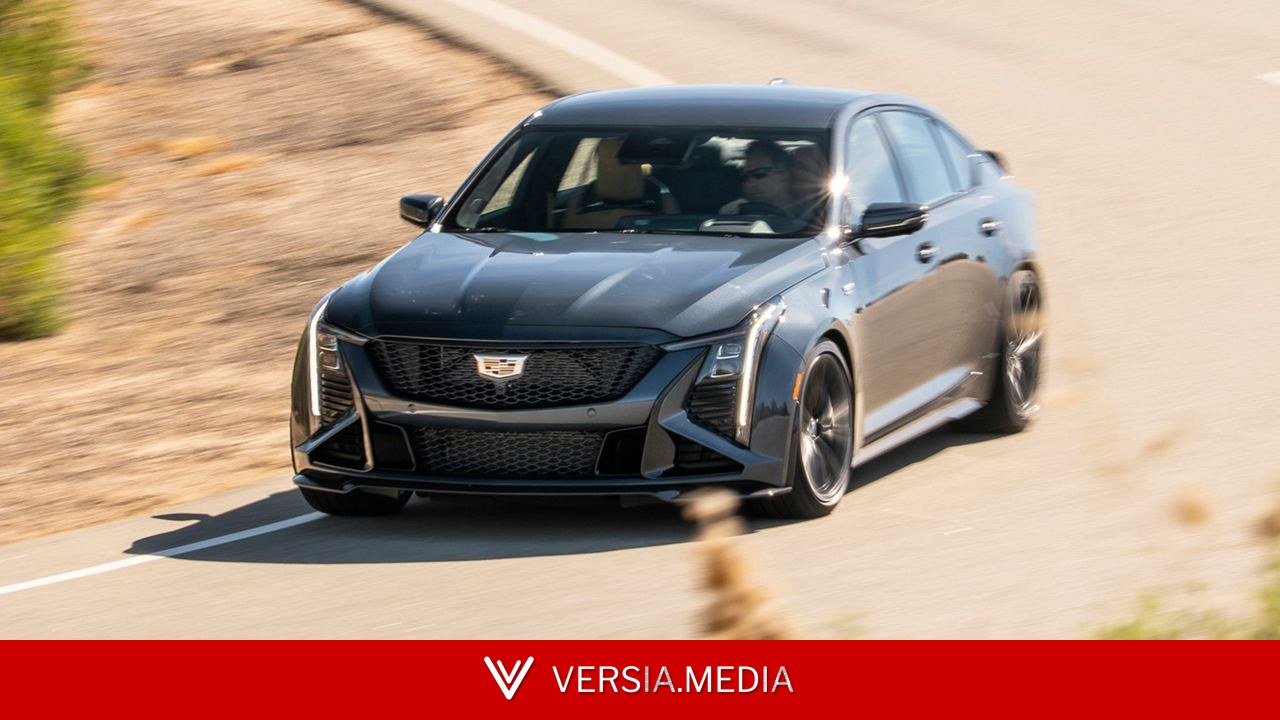
We crunch the numbers on Cadillac’s 668-hp, six-speed manual muscle car before it vanishes.
Save
See All 25 Photos 25
Pros
Exceptional power
Outstanding handling
Superb clutch and gearbox
Cons
Guzzles gas
Braking could improve on the racetrack
Snag it while you can
“Goodness gracious,” or some variation of it, is what crosses your mind when you hit the gas to launch the projectile that is the 2026 Cadillac CT5-V Blackwing. Dictionary definitions of that phrase include the terms “astonishment” and “surprise”—and indeed when you simply listen to it, feel it, and bask in its deluge of power and torque, there’s plenty of both on display here. “Dismay” can also be linked to the expression, though, and unfortunately it, too, applies in this case. Not due to any major flaw with the vehicle; quite the opposite. But Cadillac previously announced that 2026 marks the final production year for the current CT4 and CT5 sedans, including the flagship CT5-V Blackwing. A next-generation CT5 is anticipated to return eventually, but we’ll truly miss this car in the interim.
0:00 / 0:00
An Appropriate Farewell
We haven’t yet gotten our hands on the recently unveiled CT5-V Blackwing F1 Collector Series Edition, and we may never do so given its limited run (just 26 units), but the Blackwing Precision package is the next best alternative.
We previously tested the CT5-V Blackwing equipped with the new-for-last-year, $18,000 Precision package, which adds carbon-ceramic brakes, Michelin Pilot Sport Cup 2 R tires, and enhancements such as a stiffer front anti-roll bar and suspension bushings, new steering knuckles and rear-suspension toe links, plus revised calibration for the MagneRide suspension dampers, spring rates, steering, and electronic limited-slip differential.
However, that vehicle featured the optional 10-speed automatic transmission, whereas Cadillac’s press fleet operations now gave us an opportunity to run the numbers on the six-speed manual version as a final tribute to the most formidable Cadillac sport sedan ever built.
See All 25 Photos 25
How Does It Stack Up?
With the supercharged 6.2-liter V-8 engine roaring, spitting, and unleashing 668 horsepower and 659 lb-ft of torque, the automatic-equipped Blackwing tipped our scales at 4,109 pounds and sprinted from 0 to 60 mph in 3.4 seconds, with the quarter mile passing in 11.4 seconds at 127.3 mph. The slightly lighter (4,076-pound), launch-control- and no-lift-shift-equipped manual car posted times of 3.6 seconds and 11.7 seconds at 124.7 mph, precisely matching our expectations when forecasting the time needed to shift gears manually.
As for our other key testing measures, a major factor was at play compared to the automatic car we tested three months ago: the tires. The automatic Blackwing arrived at our test session riding on the Precision Package’s Michelin Pilot Sport Cup 2 R track-focused rubber, but this manual model had the available Pilot Sport 4 S tires. The latter may be more suitable for a broader range of real-world driving conditions, but if you’ve ever questioned how much outright performance difference might exist between these tire models, well, here are our data points: The automatic car on the Rs stopped from 60 mph in 97 feet, surpassing the manual car’s 106-foot distance. We also observed a somewhat soft-feeling brake pedal and desired more grip from the 19-inch Michelins. It’s worth noting that even during our test of the automatic car with the stickier tires, we encountered inconsistent hard braking performance.
See All 25 Photos 25